The Source of Arnold's Rage
For much of the Revolutionary War, Benedict Arnold was highly regarded. He played major parts in Patriot victories at Fort Ticonderoga and Saratoga, and was crippled in his failed attempt to take Quebec city. He was a favorite of George Washington and Alexander Hamilton. Behind the scenes, however, Arnold's bitterness toward the Continental Congress, and certain political figures such as John Reed and military leaders such as Horatio Gates, had reached a boiling point. Arnold had indeed been snubbed by Congress. He had been passed over for many promotions, which were instead given to those he deemed inferior. He had been largely denied credit for his military successes and took a back seat to Ethan Allen at Fort Ticonderoga and Horatio Gates at Saratoga. Furthermore, Arnold lived a lavish lifestyle and incurred significant financial debt. His new wife, Peggy, came from a family that was known to have Loyalist sentiments. It is thought that Peggy, accustomed to living the high life, encouraged his treason. Arnold came to believe that as long as there was a Continental Congress, the American experiment would never work.
Conducting Treason
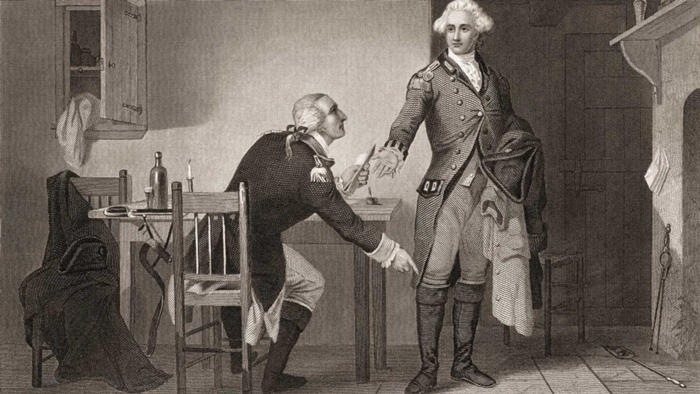
Thus, in 1780, Benedict Arnold made the decision to covertly contact British General Henry Clinton, with the intentions of surrendering the Patriot fort at West Point along the Hudson River, for which he was assigned command. From the start, Arnold's actions at the fort were suspicious. He never ordered important repairs to the fort and he also weakened its defenses by sending away weapons. Some of his subordinate officers believed he was selling the weapons on the black market for his personal gain. Negotiations for the surrender occurred between Arnold and a popular British operative named John Andrè. Among other things, Arnold would receive 20,000 Pounds and a commission as an officer in the British army. Andrè, however, would be captured carrying the plans for West Point, and would be summarily hanged. Andrè's capture made it immediately clear that Arnold was a traitor, and he narrowly escaped capture himself - saved only by a dramatic "breakdown" by his wife, Peggy, that succeeded in stalling Washington and Hamilton long enough to allow Arnold to escape to the British side. Washington, who was a chief supporter of Arnold, was said to have been devastated.
Spurned in the British Military As Well
Arnold, meanwhile, became a brigadier general in the British army, but was passed over for promotions because his traitorous actions made him untrustworthy. In 1781, Arnold led in a raid that led to the torching of New London, Connecticut, only miles from his hometown. Following the war, Arnold never returned to America. He died in England in 1801, leaving a legacy of shame that continues to this day in America. It didn't have to be that way, however. One can only speculate that if not for his treason, Arnold's place in American history would be exalted. Perhaps "Benedict" would be a common and proud name among boys today, instead of a name that parents dare not bestow upon them, for fear of the negativity it may invoke.
|
Benedict Arnold was once a respected hero of the Revolutionary War. He helped win battles at Fort Ticonderoga and Saratoga and was badly injured in a failed attempt to take Quebec. George Washington and Alexander Hamilton supported him. But behind the scenes, Arnold was angry at the Continental Congress and others like John Reed and Horatio Gates. He was passed over for promotions and felt unrecognized for his efforts. He also lived beyond his means and had large debts. His wife, Peggy, came from a Loyalist family and may have encouraged his betrayal. Arnold started to believe the American government would never succeed.
Conducting Treason
In 1780, Arnold contacted British General Henry Clinton and planned to give up the fort at West Point, where he was in command. He weakened the fort’s defenses and sent away weapons, which some thought he was selling for personal profit. Arnold worked with British spy John André and agreed to trade the fort for £20,000 and a British officer’s rank. But André was caught with the plans and was hanged. Arnold escaped only because his wife pretended to have a breakdown, delaying Washington and Hamilton. Washington was heartbroken by Arnold’s betrayal.
Rejected by the British Too
Arnold joined the British army as a brigadier general, but they didn’t trust him and never promoted him. In 1781, he led a raid that burned New London, Connecticut—close to where he grew up. After the war, Arnold never returned to America. He died in England in 1801, remembered as a traitor. Some believe that if he had stayed loyal, he would be celebrated as one of America's greatest heroes. Instead, his name is now linked to betrayal, and few would name their child “Benedict” today because of him. |