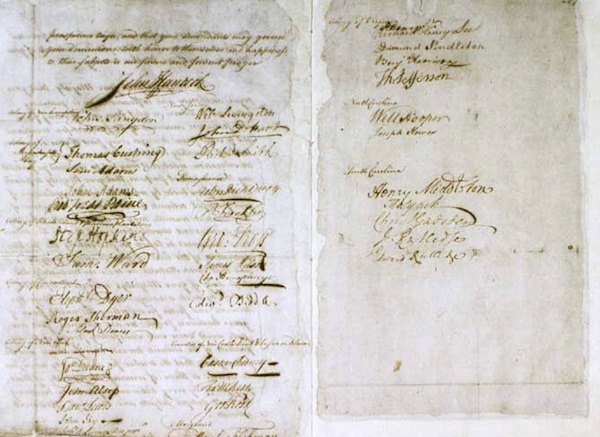
The Olive Branch Petition |
|
The Olive Branch Petition was a document sent by the Continental Congress to King George III in July 1775, during the early stages of the American Revolutionary War. The petition was a last ditch effort by the colonists to avoid an all-out war with Britain and to reconcile with the British government.
The petition was written by John Dickinson and was signed by the President of the Continental Congress, John Hancock. It was sent to King George III along with a letter from Hancock, in which he stated that the colonists were not seeking independence from Britain, but rather a peaceful resolution to their grievances. The Olive Branch Petition stated that the colonists were willing to accept any reasonable terms for reconciliation, and that they were still loyal subjects of the British Crown. The petition also acknowledged that some of the colonists had taken up arms against the British government, but that this had been done out of a sense of necessity, and that the colonists were willing to lay down their arms if the King were to offer them reasonable terms for reconciliation. The King, however, rejected the Olive Branch Petition and instead issued a Proclamation of Rebellion in August of 1775. In it, he declared the colonies to be in a state of rebellion and ordered the raising of additional troops to put down the rebellion. Discussion Questions
Glossary
In July 1775, during the early part of the American Revolutionary War, the Continental Congress sent a message to King George III called the Olive Branch Petition. It was a final attempt by the colonists to avoid a full war and make peace with Britain. What Did the Petition Say?The petition, written by John Dickinson and signed by John Hancock, said that the colonists were still loyal to the King. They were not asking for independence but wanted a peaceful solution to their problems with the British government. It also admitted that some colonists had taken up weapons, but said this was only because they felt it was necessary. They were willing to stop fighting if the King would agree to fair terms. How Did the King Respond?King George III rejected the petition. Instead, in August 1775, he issued a Proclamation of Rebellion. He declared that the colonies were in open rebellion and ordered more British troops to stop the uprising. |