Why did John Adams Defend the Soldiers Accused of Murder in the Boston Massacre? |
|
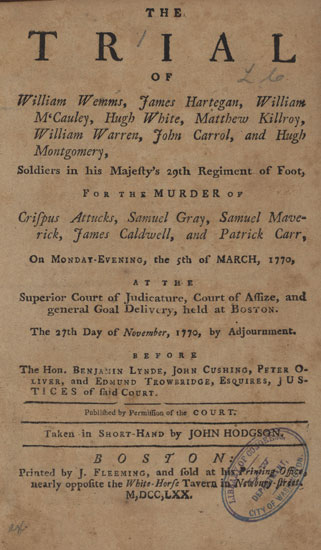
Fairness, FirstFollowing the Boston Massacre on March 5, 1770, Captain Thomas Preston, eight British soldiers, and five British civilians were indicted for murder, thus, facing possible execution. Unfortunately for the accused, it was very difficult to find a defense team that would agree to defend them in the very anti-British city of Boston. John Adams realized that much was on the line for colonial America, not the least of which was its international reputation. He realized it was critical for the accused to have a fair trial, lest other nations view colonial America as a place where justice and due process are not respected or applied to all. A fair trial might also prevent retaliation from the British. Furthermore, Adams had gained a personal reputation as incorruptible, and firmly believed that the accused had the right to a fair trial and a competent defense, even though he bitterly hated their cause. Branded on the Thumbs?In the trial that ensued, Adams argued that Captain Preston had never issued the order for his soldiers to "fire," and that those who had shot into the crowd did so entirely in self-defense. Adams called those within the mob that provoked the soldiers "outlandish Jack tarrs," among other things. Adams' persuasion won the day, and Preston and six of his soldiers were acquitted of all charges. Two soldiers were found guilty of manslaughter and were punished by having their thumbs branded. Ultimately, Adams was proud of his service to the British soldiers. Later in his life he wrote: "The Part I took in Defence of Cptn. Preston and the Soldiers, procured me Anxiety, and Obloquy enough. It was, however, one of the most gallant, generous, manly and disinterested Actions of my whole Life, and one of the best Pieces of Service I ever rendered my Country. Judgment of Death against those Soldiers would have been as foul a Stain upon this Country as the Executions of the Quakers or Witches, anciently. As the Evidence was, the Verdict of the Jury was exactly right. This however is no Reason why the Town should not call the Action of that Night a Massacre, nor is it any Argument in favour of the Governor or Minister, who caused them to be sent here. But it is the strongest Proofs of the Danger of Standing Armies." Discussion Questions
Glossary
Fairness FirstAfter the Boston Massacre on March 5, 1770, Captain Thomas Preston, eight British soldiers, and five civilians were put on trial for murder. It was hard to find anyone in Boston willing to defend them because many people were angry at the British. John Adams, a respected lawyer, agreed to help them. He believed everyone deserves a fair trial, even those he disagreed with. He also knew that if the trial was unfair, it could hurt America's reputation with other countries and lead to more violence from the British. A Fair TrialAt the trial, Adams argued that Captain Preston never told the soldiers to fire and that they only shot to protect themselves. He claimed the crowd had acted in a threatening way. The jury agreed, and Preston and six soldiers were found not guilty. Two soldiers were found guilty of manslaughter and had their thumbs burned as punishment. Adams’ ReflectionLater, Adams said he was proud of what he did, even though people criticized him. He believed that giving the soldiers a fair trial was one of the best things he ever did for his country. He warned that keeping standing armies in peaceful cities could be dangerous. |