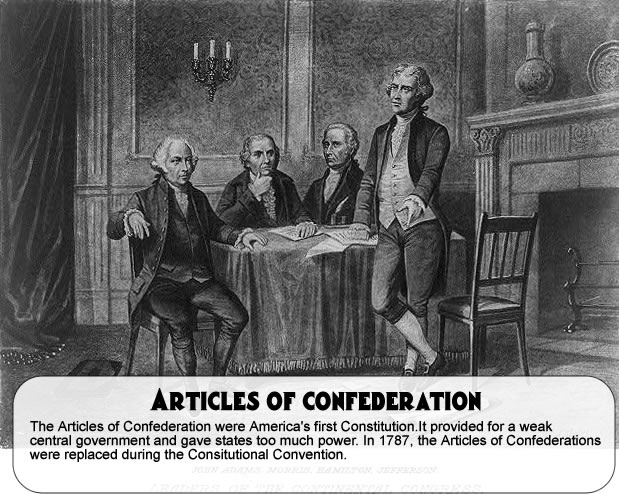
Articles of Confederation |
|
During the first few years in which the Continental Congress was in operation, state or popular control had not yet been established. Nevertheless, the Continental Congress had initiated the establishment of the Continental Army and of a national currency. A Need for a Formal GovernmentWhen America officially declared its independence from Great Britain in 1776, it recognized a need for a more formal governing body and a more official alliance between the states. Thus, the United States of America was established under the Articles of Confederation. The Articles were adopted in 1776, and ratified by March of 1781. Weaknesses in the ArticlesAmerica’s new national government had a single legislative body, the Confederation Congress, in which each of thirteen states had one vote. However, the original government run under the Articles of Confederation was nothing like our representative government today. It had few powers and had no jurisdiction over American citizens. The Articles provided no authority to tax citizens, rather revenue would have to be generated by requesting money form the states. Furthermore, language within the Articles of Confederation made it very difficult to change laws. All 13 states had to agree if amendments were to be made. Although the Articles of Confederation were a stepping stone to the American Constitution, they were inadequate as a means to govern a new nation. Many of the states failed to pay their shares of the national budget, and there was a constant threat of uprisings among unpaid veterans of the Continental Army. Improvements were not made until the Philadelphia or Constitutional Convention was held in 1787. In the early years of the Continental Congress, there was no clear state or public control. Still, the Congress created a national army and a currency.
A Need for a Formal GovernmentWhen the colonies declared independence from Britain in 1776, they realized they needed a stronger government. This led to the creation of the Articles of Confederation, which were adopted in 1776 and fully ratified by 1781.Weaknesses in the ArticlesThe new national government had one legislative body called the Confederation Congress, with each state having one vote. However, the government had very little power. It couldn’t tax people or enforce laws directly. Changing the Articles was hard because all 13 states had to agree. Many states didn’t pay their share of the budget, and unrest grew, especially among unpaid soldiers. These problems led to the Constitutional Convention in 1787, where a stronger government was designed. |
| Articles of Confederation Activities |