Alexander Hamilton's Assumption Plan

Hamilton's Assumption Plan

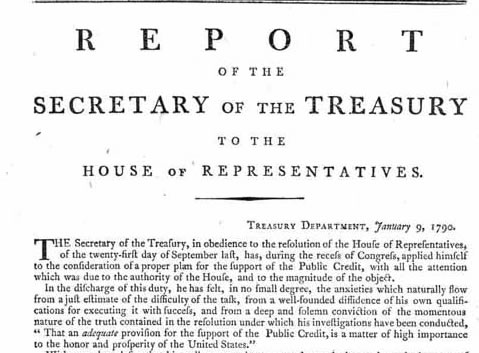
As President George Washington's Secretary of the Treasury, Alexander Hamilton made many controversial proposals and programs aimed at strengthening the new nation's financial state. In his landmark "Report on Public Credit," Hamilton made a proposal that would send shockwaves through the leadership of the new nation. During the American Revolution, the states (former colonies) incurred significant debts. Hamilton proposed that the new Federal Government assume the state debts. To Hamilton, this would legitimize and strengthen the Federal Government by putting it in charge of a national debt, rather than each state being in charge of its individual debt.

Opposition to Hamilton's idea came from political rivals Thomas Jefferson and James Madison who believed the plan gave too much power to the Federal Government. Furthermore, their home state of Virginia had already paid half of its individual debt. Madison also opposed other parts of Hamilton's plan which called for the postponement of payment on debts previously incurred by the Federal Government. The Federal Government did not have the money to pay bonds issued to veterans of the Revolutionary War. As a result, these bonds were being sold at a fraction of their face value, making speculators rich. The divergence of viewpoint between Jefferson, Madison, and Hamilton only increased as time progressed, resulting in a major rift and eventually the formation of two distinct parties: the Federalists, led by Hamilton, and the Republicans, led by Jefferson. Eventually, however, Hamilton's Assumption plan would be approved on July 26, 1790, after he, Jefferson, and Madison made a compromise: Hamilton agreed to use his influence to locate the nation's capital along the Potomac River and Jefferson and Madison agreed to lobby for approval of Assumption in Virginia. A southern capital was important to Jefferson and Madison so that the more populated northern states would not exert undo power on the southern states.

As President George Washington's Secretary of the Treasury, Alexander Hamilton created plans to strengthen the new country's finances. In his "Report on Public Credit," he suggested that the Federal Government should take over the debts that the states had from the American Revolution. He believed this would give the Federal Government more power and make it stronger by managing a national debt instead of each state handling its own debt.

Opposition from Jefferson and Madison

Thomas Jefferson and James Madison opposed Hamilton’s plan. They thought it gave the Federal Government too much control. Also, Virginia, their home state, had already paid off much of its debt. Madison also didn’t like Hamilton’s idea to delay paying some of the government’s debts, which hurt veterans who had sold their war bonds cheaply to speculators who were getting rich.

Creation of Political Parties

The disagreements between Hamilton, Jefferson, and Madison grew over time. These differences eventually led to the creation of two political parties: the Federalists, led by Hamilton, and the Republicans, led by Jefferson.

The Compromise

On July 26, 1790, Hamilton's plan was finally approved after a deal was made. Hamilton agreed to help move the nation’s capital to a location along the Potomac River. In return, Jefferson and Madison promised to support Hamilton’s debt plan in Virginia. Jefferson and Madison wanted the capital in the South so that northern states wouldn’t have too much power over the southern states.