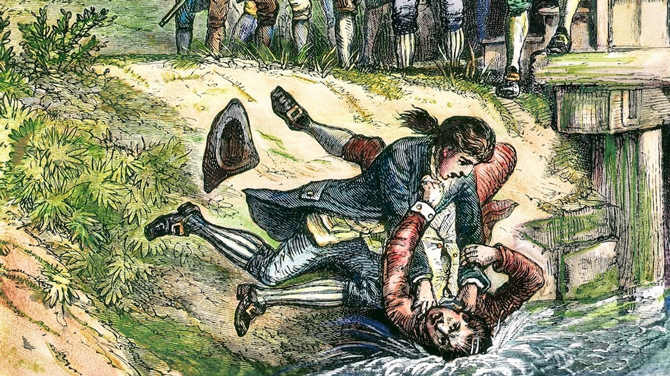
Shay's Rebellion |
Why did the Farmers Rebel?Shays Rebellion was an uprising among Massachusetts farmers who were veterans of the Revolutionary War in 1786-1787, in response to the state's demand that they pay individual taxes, despite having been paid very little or nothing at all for their service. Furthermore, local businesses started to demand immediate payment on goods that farmers had bought on credit. Consequently, many farmers were facing the forfeiture of their land or incarceration, because they could not pay taxes or debts. Massachusetts Governor James Bowdoin showed little sympathy to the plight of his state's farmers, but rather, was more concerned that his business associates made profits on their investments. Throughout 1786, Daniel Shays, a veteran of the Revolutionary War who fought at the Battle of Bunker Hill, led armed protests and shutdowns of various state courthouses, preventing trials involving land forfeitures, foreclosures, and criminal proceedings against farmers in debt. As the crisis escalated, the Massachusetts General Court enacted contradictory incentives and laws. Although it passed a law that granted clemency to "rebels" that disavowed the rebellions and pledged allegiance to the Massachusetts government, it also passed laws giving clemency to any law enforcement agents that killed rebels. Harsh penalties were also given to prisoners already in custody. The stage was set for a possible battle. Shays Attempts to Seize the Federal Arsenal at SpringfieldOn January 25, 1787, a mob of 1,200 farmers led by Daniel Shays, made an unsuccessful attempt to seize weapons from the Springfield Arsenal, in western Massachusetts. The federal government could not muster the soldiers or finances to assist in warding off the mob, rather, the Massachusetts militia was tasked with quelling the rebellion. 4,400 militiamen under Benjamin Lincoln met the rebellion and easily defeated it. In the small battle that ensued, two rebels were killed. Following the rebellion, the new Governor of Massachusetts, John Hancock, pardoned most of the rebels, but two, who were also accused of burglary, were hanged. The Massachusetts government then passed the Disqualification Act, which prohibited rebels from participating in a range of public and private offices for a period of three years. The Rebellion Exposes Major Problems with the GovernmentShays Rebellion is often considered a consequence of the federal government’s inability to collect tax revenue from the states, under the Articles of Confederation. The toothless response of the government was one of the main catalysts in the decision to replace the Articles of Confederation, which gave the federal government no ability to raise money from the states. The magnitude of the event was greatly exaggerated outside of Massachusetts and caused great consternation among many of the Founding Fathers, including George Washington. Washington, who was afraid Shays Rebellion signaled the failure of the "American Experiment," which was predicted by several European Nations, lent his support to the replacement of the Articles of Confederation, and agreed to preside over the Constitutional Convention. This decision gave legitimacy to the convention, and ensured it would be taken seriously throughout the states.
Shays' Rebellion happened in 1786–1787 when farmers in Massachusetts protested unfair taxes. Many of the farmers were veterans of the Revolutionary War and had been paid little or nothing. On top of that, businesses wanted quick payments for goods bought on credit. This led to farmers losing their land or being sent to jail for debts. The state’s governor, James Bowdoin, cared more about protecting business profits than helping the struggling farmers. Daniel Shays Takes ActionDaniel Shays, a war veteran, led protests to shut down courthouses so farmers couldn’t be taken to court or lose their land. The state passed confusing laws—offering forgiveness to rebels who pledged loyalty, but also allowing law officers to kill rebels without punishment. The situation became very tense. Attack on the Springfield ArsenalOn January 25, 1787, Shays led 1,200 farmers in an attempt to take weapons from the Springfield Arsenal. The federal government was too weak to help, so the state militia stopped the attack. Two rebels were killed. Later, Governor John Hancock pardoned most rebels, but two were hanged for burglary. A new law banned rebels from holding public office for three years. Weak Government ExposedShays’ Rebellion showed how weak the U.S. government was under the Articles of Confederation. It couldn’t collect taxes or raise money. Many leaders, including George Washington, feared the government was failing. Washington supported creating a new Constitution and agreed to lead the Constitutional Convention. His support helped ensure the new government would be taken seriously. |