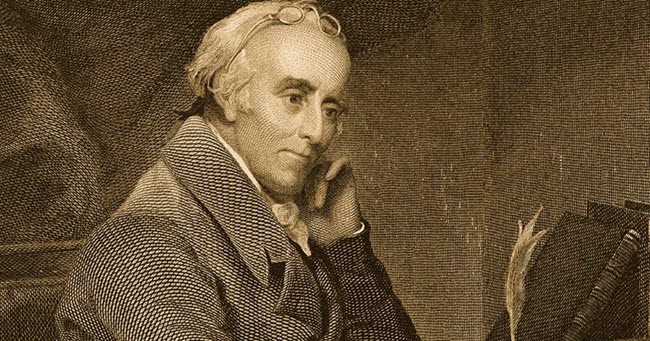
Dr. Benjamin Rush |
|
Benjamin Rush was born on December 24, 1745, in Byberry, Pennsylvania. He received his medical education at the College of New Jersey (now Princeton University) and went on to establish a successful medical practice in Philadelphia. He was a passionate advocate for the Patriot cause and was involved in various political and military activities during the American Revolution. A Pioneer in Early MedicineIn addition to his medical and political achievements, Rush was also a well-respected educator and was known for his commitment to promoting education and public health. He was a founding member of several institutions, including the College of Physicians of Philadelphia, the American Philosophical Society, and the Pennsylvania Hospital. Supporting IndependenceRush was also a noted abolitionist and advocated for the abolition of slavery throughout his life. He served as a delegate to the Continental Congress and signed the Declaration of Independence. He was instrumental in the ratification of the United States Constitution in his home state of Pennsylvania. In addition, he served as the Surgeon General of the Continental Army. Ahead of his TimeAside from his political and educational achievements, Rush was also a pioneering physician who made significant contributions to the field of medicine. He was one of the first American physicians to advocate for the use of vaccinations and was a vocal advocate for mental health, publishing several influential works on the topic. The American Psychiatric Association deemed him the "father of American psychiatry" in 1965. Benjamin Rush was born on December 24, 1745, in Byberry, Pennsylvania. He studied medicine at the College of New Jersey, which is now called Princeton University. He later became a successful doctor in Philadelphia. He strongly supported American independence and took part in both political and military work during the American Revolution. A Pioneer in MedicineBesides being a doctor and a political leader, Rush cared deeply about education and public health. He helped start important organizations like the College of Physicians of Philadelphia, the American Philosophical Society, and the Pennsylvania Hospital. Support for American IndependenceRush spoke out against slavery for his whole life. He signed the Declaration of Independence and helped Pennsylvania approve the U.S. Constitution. He also served as the top doctor (Surgeon General) for the Continental Army during the Revolutionary War. Ahead of His TimeRush made important advances in medicine. He supported using vaccines and believed in treating mental health issues seriously. He wrote books about mental illness and how to care for patients. In 1965, the American Psychiatric Association called him the "father of American psychiatry." |