James Madison |
||
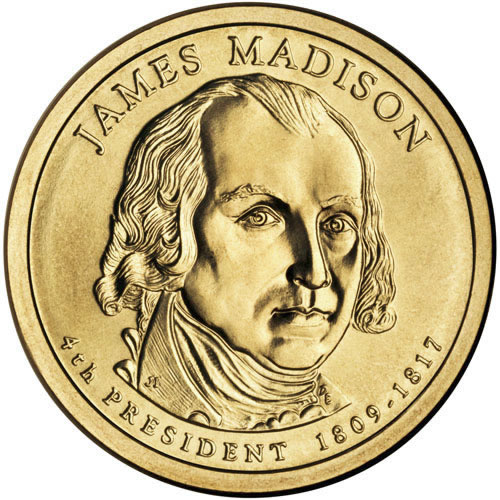
Father of the ConstitutionJames Madison was born on March 16, 1751, in King George County,Virginia. He graduated from Princeton University at the age of 20 in 1771. He served in the Virginia Constitutional Convention in 1776. In 1780, Madison served as a delegate to the Second Continental Congress. Madison served as the chief recorder at the Constitutional Convention in 1787. He is regarded as the “Father of the Constitution" for his ambitious Virginia Plan, which proposed that representation in both houses of Congress should be proportionate to a state's population. Later in 1787, Madison teamed with Alexander Hamilton (and to a small extent, John Jay) to write the Federalist Papers, a series of persuasive essays designed to convince the states to ratify the Constitution. Written under the pen name “Publius,” the Federalist Papers is considered one of the most important documents in American history. The Democratic PartyIn 1789, Madison was elected to the House of Representatives, where he helped draft the Bill of Rights and fought against passage of the Alien and Sedition Acts. Madison married Dolley Payne Todd in 1794. He helped found the Democratic Party and was chosen as Jefferson’s secretary of state in 1801. As a leader of the Democrats, Madison believed that power should be invested in the states rather than a central government, and that the nation's economy should ultimately be powered by agriculture. In contrast to the Federalists, Madison believed in forging diplomatic and economic relationships with France rather than England. Presidency and War of 1812Madison was elected as America’s fourth president in 1808. George Clinton was appointed vice president but died in office in 1812. Madison’s first term was plagued by tensions with Great Britain, and his foreign policy was widely criticized. Despite the problems that characterized his first term, Madison was reelected in 1812 for a second term. Elbridge Gerry was appointed vice president, but he too died in office in 1814. During Madison’s second term, he guided the nation through The War of 1812 with Great Britain, which many called the second American Revolution. Unfortunately, the peace treaty signed between the two countries ultimately settled few of the issues between the countries. Later YearsFollowing his second term, Madison left politics and retired to his home in Virginia, Monticello. He died in 1836 at the age of 85.
Famous Quote"If men were angels, no government would be necessary." – James Madison Discussion Questions
Glossary
Five Interesting Facts
Timeline of James Madison's Life
James Madison was born on March 16, 1751, in Virginia. He graduated from Princeton University in 1771. He helped write Virginia’s first constitution in 1776 and was a delegate to the Second Continental Congress in 1780. In 1787, he took notes at the Constitutional Convention and proposed the Virginia Plan, which supported population-based representation in Congress. He is known as the “Father of the Constitution.” Later that year, he worked with Alexander Hamilton and John Jay to write the Federalist Papers to encourage states to approve the Constitution. The Democratic PartyIn 1789, Madison was elected to the House of Representatives. He helped write the Bill of Rights and opposed the Alien and Sedition Acts. In 1794, he married Dolley Payne Todd. He helped start the Democratic Party and became Secretary of State in 1801 under President Thomas Jefferson. Madison believed in strong state governments and an economy based on farming. He supported closer ties with France rather than England. Presidency and War of 1812Madison became the fourth U.S. president in 1808. His first term had problems with Great Britain. Despite this, he was re-elected in 1812. Both of his vice presidents, George Clinton and Elbridge Gerry, died in office. Madison led the country through the War of 1812 against Britain. The war ended in a peace treaty, but it didn’t solve many of the issues. Later YearsAfter his presidency, Madison retired to his Virginia home, Montpelier. He died in 1836 at the age of 85. |
||
| James Madison Activities | ||
|