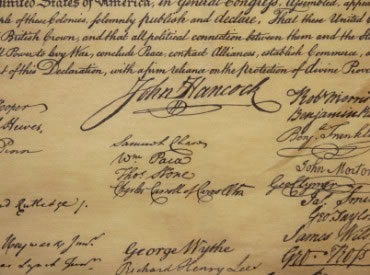
John Hancock |
||
Who was John Hancock?John Hancock was raised by his uncle in Boston, Massachusetts. His uncle sent him to Harvard University and made him a partner in his shipping company. When his uncle died in 1764, John became one of Boston’s wealthiest citizens.
Smuggling to Support IndependenceIn 1765, John was elected to the office of Boston Selectmen. He quickly joined Samuel Adams and the Sons of Liberty and became a strong opponent of the Stamp Act, a tax levied against the colonists by Great Britain. In 1768, John was appointed as a representative of the Massachusetts Legislature. He soon gained the reputation as a strong advocate of American independence. In fact, it was John’s shipping company that enabled the financing and smuggling of goods that supported the region’s resistance to the British. On the British "Most Wanted" ListIn 1774, one year after Great Britain levied the Intolerable (Coercive) Acts against the colonists, John was elected president of the Massachusetts Provincial Congress, a new Massachusetts legislature which had the authority to call for troops in the wake of a British threat. The British subsequently charged Hancock with treason. In 1775, British troops would march to Lexington with the orders to capture John Hancock. It was during this march that the first shots of the American Revolution were fired. John, along with Samuel Adams, ultimately escaped.
President of the Second Continental Congress; Iconic SignatureLater in 1775, John was appointed president of the Second Continental Congress. It was John Hancock who commissioned George Washington as commander in chief of the Continental Army. On July 4, 1776, John Hancock became the first American to sign the Declaration of Independence. His large, flamboyant signature was by far the most visible of all signatures. According to legend, Hancock signed the document in such a way so that King George II of England could see the signature without his eyeglasses. Why did Hancock Really Sign so Big?The famous story says that John Hancock signed his name so large on the Declaration of Independence so King George III could read it without his glasses. While this is a fun tale, historians believe it is more legend than fact. The real reasons are more likely:
In short, John Hancock’s big signature was likely a mix of position, personality, and patriotism—not just to help the king read it. A Fervent Patriot ForeverThroughout the Revolution, the Americans relied on John’s ability to raise funds and supplies for the Continental Army. In 1780, he was elected governor of Massachusetts, a post he held for nine terms. John died in 1793. Today, counties in ten different states are named in his honor. In addition, the tallest building in Boston is named the John Hancock Building. Discussion Questions
Glossary
Five Interesting Facts
Timeline
John Hancock grew up in Boston, raised by his wealthy uncle. He went to Harvard and later joined his uncle’s shipping business.
When his uncle died in 1764, John became one of the richest people in Boston.
Smuggling to Support IndependenceIn 1765, John became a Boston Selectman and joined Samuel Adams and the Sons of Liberty. He strongly opposed British taxes like the Stamp Act. In 1768, he was elected to the Massachusetts Legislature. His shipping company helped secretly bring in supplies to support the fight against British control. On the British "Most Wanted" ListIn 1774, John became president of the Massachusetts Provincial Congress, which had the power to call for soldiers. The British charged him with treason. In 1775, British troops marched to Lexington to arrest John and Samuel Adams. They escaped, and the first battle of the American Revolution began. President of the Second Continental CongressLater in 1775, John became president of the Second Continental Congress. He chose George Washington to lead the Continental Army. On July 4, 1776, he was the first to sign the Declaration of Independence. His signature was big and bold—legend says he signed it large enough for King George to read without glasses. A Fervent Patriot ForeverDuring the war, John helped raise money and supplies for the American army. In 1780, he was elected governor of Massachusetts and served nine terms. He died in 1793. Today, many places are named after him, including the tallest building in Boston—the John Hancock Building. |
||
| John Hancock Activities | ||
|