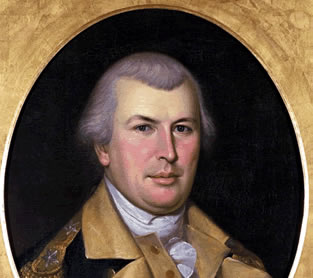
Nathanael Greene |
Thoughts and Actions Incompatible with Quaker SocietyNathanael Greene was born near Warwick, Rhode Island, on August 7, 1742. His parents were strict Quakers. He was largely self-educated and took a special interest in mathematics and military tactics. In 1770, he moved to Coventry, Rhode Island, and was chosen as a member of the Rhode Island General Assembly. He was reelected in 1771, 1772, and 1775, and began to sympathize with the Patriot cause. In 1774, he married Catherine Littlefield. Later that year, Greene established a local militia and resumed his study of war tactics. Because of his involvement in warlike activities, he was expelled from Quaker society. Promoted by George WashingtonIn 1775, Greene organized a group of men to join the Patriot cause in Boston. In May of that year, he was promoted to brigadier general of the Rhode Island Army of Observation. In June of 1775, he was appointed brigadier of the Continental Army. In March of 1776, General George Washington appointed him in command of the city of Boston after British forces had evacuated. In August of 1776, Greene was promoted to major general and placed in command of Continental troops on Long Island, NY. He would see action in many important battles including the Battles of Trenton, Brandywine, Germantown, and Monmouth. Greene Directs Victories in the Southern TheaterAfter serving as quartermaster general (staff officer in charge of the army's supplies) until 1780, in between leading troops into battle, Greene was assigned to take over command of the Southern Army. This was a particularly important position as the British had decimated the Southern forces and were poised to control the entire southern portion of the colonies. Greene made the strategic decision to split his forces, which in turn provoked the British to do the same. Rather than having to fight one army against the other, Greene's plan would force smaller detachments to fight. The plan worked brilliantly. Patriot forces, able to engage in guerilla-style warfare, won surprising battles at Cowpens and King's Mountain in South Carolina. Furthermore, they inflicted heavy casualties on the British Army at Guilford Courthouse, North Carolina, and later at Eutaw Springs, South Carolina. The battles weakened the British Army, forced them to retreat north into Virginia and east to Charleston, and raised the morale of the Patriots. Greene's management of the Southern Army was crucial to the eventual British surrender at Yorktown. Strong LegacyAfter the war, Greene was given a land grant by the state of Georgia. He named it Mulberry Grove. Although he was offered the position of secretary of war twice, he refused. He died in 1786, apparently of sunstroke. He is remembered as a general of great military intellect. Other than George Washington, he was the only general to serve all eight years of the Revolutionary War. Statues of Nathanael Greene stand in Savannah, Georgia, and at the Guilford Courthouse battle site. The city of Greensboro, North Carolina, is named after him. Nathanael Greene was born on August 7, 1742, near Warwick, Rhode Island. He was raised in a strict Quaker family. He taught himself and was especially interested in math and war strategies. Greene joined the Rhode Island General Assembly and supported the Patriot cause. In 1774, he started a local militia. Because Quakers are against war, he was removed from the Quaker group for his military activities. Rising Through the RanksIn 1775, Greene led a group of soldiers to help the Patriots in Boston. He quickly rose through the military ranks and was made a brigadier general. George Washington trusted him and gave him command of Boston in 1776. Greene fought in many key battles, including Trenton, Brandywine, Germantown, and Monmouth. Leading in the SouthIn 1780, Greene became the leader of the Southern Army. The British had almost taken over the South. Greene used a smart plan: he split his army to confuse the British. This led to big wins at battles like Cowpens and King’s Mountain. His troops also hurt the British at Guilford Courthouse and Eutaw Springs. These victories weakened the British and helped lead to their surrender at Yorktown. LegacyAfter the war, Greene was given land in Georgia and named it Mulberry Grove. He turned down the chance to be Secretary of War twice. He died in 1786, likely from sunstroke. Greene is remembered as a smart and loyal general. He was one of only two generals, along with George Washington, to serve for the entire Revolutionary War. Places like Greensboro, North Carolina, and statues in Georgia honor his legacy. |