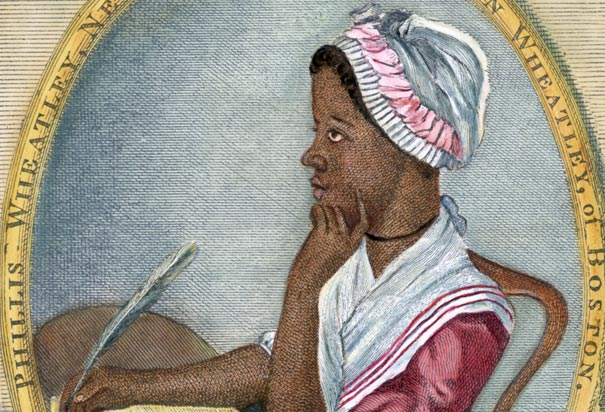
Phillis Wheatley |
Early LifePhillis Wheatley was born in Gambia on May 8, 1753. When she was 7 or 8, she was sold as a slave to John and Susanna Wheatley of Boston. She was named after the ship that brought her to America, the Phillis. The Poetry Foundation describes her sale below: In August 1761: "in want of a domestic," Susanna Wheatley, ... purchased "a slender, frail female child ... for a trifle"... The captain of the slave ship believed that the waif was terminally ill, and he wanted ... at least a small profit before she died. ...The family surmised the girl - who was "of slender frame and evidently suffering from a change of climate," nearly naked, with "no other covering than a quantity of dirty carpet about her" - to be "about seven years old ... from the circumstances of shedding her front teeth." (https://www.poetryfoundation.org/bio/phillis-wheatley) The 12 Year-old PoetPhillis was very intelligent. The Wheatley family taught her to read and write, and encouraged her to write poetry. Her first poem "On Messrs. Hussey and Coffin" was published when she was only twelve. In 1770, An Elegiac Poem, on the Death of that Celebrated Divine, and Eminent Servant of Jesus Christ, the Reverend and Learned George Whitefield made her famous. It was published in Boston, Newport, and Philadelphia.Short-lived FameWhen she was eighteen, Phillis and Mrs. Wheatley tried to sell a collection containing twenty-eight of her poems. Colonists did not want to buy poetry written by an African. Mrs. Wheatley wrote to England to ask Selina Hastings, Countess of Huntingdon, for help. The countess was a wealthy supporter of evangelical and abolitionist (anti-slavery) causes. She had Poems on Various Subjects, Religious and Moral published in England in 1773. This book made Phillis famous in England and the thirteen colonies. In 1775, Phillis wrote a poem for George Washington, who praised her work. They met in 1776. Phillis supported independence for the colonies during the Revolutionary War.She became the first African American and the first slave in the United States to publish a book.
Phillis Wheatley's Work A Short LifeAfter her master died, Phillis was emancipated (freed). She married John Peters, a free black man, in 1778. She and her husband lost two children as infants. John would be imprisoned for debt in 1784. Phillis, who suffered from respiratory ailments for most of her life, died in December of 1784, and was buried in an unmarked grave.
Phillis Wheatley was born in Gambia on May 8, 1753. At the age of 7 or 8, she was taken from Africa and sold as a slave to John and Susanna Wheatley in Boston. She was named after the ship that brought her to America, the Phillis. The captain of the ship thought she was very sick and sold her for a small price. The Young PoetPhillis was very smart. The Wheatley family taught her to read and write, and they encouraged her to write poems. Her first poem was published when she was just 12 years old. In 1770, a poem she wrote about a preacher named George Whitefield made her well known in cities like Boston, Newport, and Philadelphia. Fame and StrugglesWhen she was 18, Phillis and Mrs. Wheatley tried to publish more of her poems, but people in the colonies didn’t want to buy poetry written by an African. Mrs. Wheatley asked a supporter in England, Countess of Huntingdon, for help. With her support, Phillis published a book in England in 1773. It was the first book published by an African American and by a slave. In 1775, Phillis wrote a poem for George Washington, and they met in 1776. She supported American independence during the Revolutionary War. Later Life and DeathAfter her master died, Phillis was freed. She married a free Black man named John Peters in 1778. They lost two children as infants, and in 1784 John was jailed for debt. Phillis had breathing problems for much of her life and died in December 1784. She was buried in an unmarked grave. |
| Phillis Wheatley Activities |
|