Robert Morris |
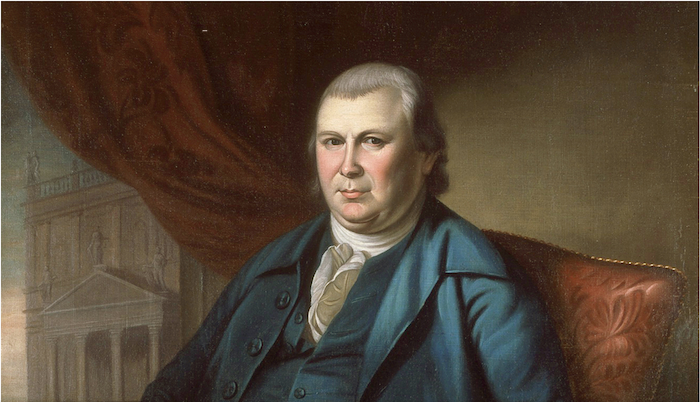 |
One of Philadelphia's EliteRobert Morris was born in Liverpool, England in 1734. At the age of 13, he emigrated to Maryland to work on his father's tobacco plantation near Oxford, Maryland. Robert continued his education in Philadelphia and soon became a clerk in a shipping business of the future mayor of Philadelphia, Charles Willing. Robert then became a partner in the business with Willing's son, and the business became one of the mot profitable in all of Pennsylvania. Robert Morris became one of Philadelphia's most wealthy and influential citizens. Against the Stamp ActIn 1765, Robert joined a local band of businessmen in protest of the Stamp Act, a new tax levied by Parliament on all printed documents. Like most residents of Philadelphia, Morris believed the tax was unfair because the colonists were not represented in Parliament. Morris helped convince the local tax collector to abandon his efforts or risk the destruction of his home. Similar incidents throughout the colonies caused Parliament to repeal the tax soon after it was issued. A Staunch Patriot and Member of CongressIn 1769, Morris married Mary White, who was fifteen years younger than him. Together, they would have seven children. As the push for revolution gained steam, Morris became more and more influential. In 1775, he was elected as one of Pennsylvania's delegates to the First Continental Congress and became heavily involved in raising money to support the push for independence from Great Britain. In 1776, he was appointed by Congress as an official fundraiser for the Continental Army. Morris even donated $10,000 of his own money to help improve the decrepit state of the army. Plan for a National BankMorris' greatest contribution, however, may have been his plan for a national bank, submitted in 1781. His plan was quickly approved by Congress and became the Bank of North America, which stabilized the new nation's shaky economy and helped establish American credit with European nations. Congress then made Robert Morris the nation's first Secretary of the Treasury and put him in charge of managing the bank. Relatively Unheralded in HistoryAfter the Revolution, Morris served as a delegate to the Constitutional Convention and as Senator of Pennsylvania. After completing his term as Senator, Morris retired from public office. Although Morris was once a very wealthy man, he never recovered from the vast contributions he made during the Revolution. Furthermore, his land investments in western New York failed. Robert Morris died in 1806 as a relatively poor man. One of Philadelphia's EliteRobert Morris was born in England in 1734 and moved to Maryland at age 13 to work on his father’s tobacco farm. He later moved to Philadelphia, became a clerk in a shipping business, and eventually a successful partner. Morris became one of the richest and most influential men in Philadelphia. Against the Stamp ActIn 1765, Morris joined local businessmen in opposing the Stamp Act, a British tax on printed materials. He and others felt it was unfair since colonists had no voice in Parliament. Their protests helped force Parliament to cancel the tax. A Staunch Patriot and Member of CongressMorris married Mary White in 1769, and they had seven children. He became active in the independence movement and was elected to the First Continental Congress in 1775. He raised money for the Continental Army and even donated $10,000 of his own money to help the cause. Plan for a National BankIn 1781, Morris proposed a national bank to help fix the weak American economy. Congress approved the plan, and the Bank of North America was created. He became the first U.S. Secretary of the Treasury and helped build American credit overseas. Relatively Unheralded in HistoryAfter the war, Morris served in the Constitutional Convention and as a Senator from Pennsylvania. He retired from politics, but lost much of his wealth due to personal financial losses and failed land deals. He died in 1806 with little recognition and not much money. |