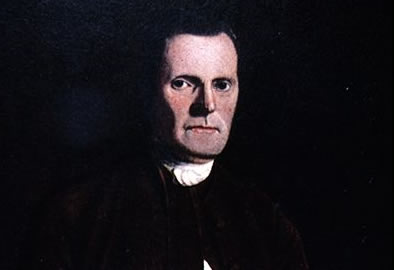
Roger Sherman |
Early Life and EducationRoger Sherman was an American lawyer and politician. He was born on April 19, 1721, in Newton, Massachusetts. After finishing grammar school, Sherman took a job as a shirt maker. He never attended college, though he was said to be an avid reader and mathematician. Burgeoning Law Career in ConnecticutIn 1743, Sherman and his family moved to New Milford, Connecticut, where he and his brother started the new town's first store. The Sherman brothers quickly became prominent citizens of and Roger eventually became town clerk. In 1745, Roger became surveyor of New Haven County, Connecticut. Despite his lack of formal education, Sherman became interested in law and passed the Connecticut Bar Exam in 1754. The next year, Sherman was chosen to represent New Milford in the Connecticut General Assembly. In 1758, he was appointed as a justice of the Superior Court of Connecticut. Involved in the Drafting of the Declaration of Independence and the ConstitutionBefore the American Revolution, Sherman was appointed as the commissary to the Connecticut troops. In 1774, he was elected as a member of the Continental Congress where he served on the committee to draft the Declaration of Independence. Sherman later served on the committee that wrote the Articles of Confederation in 1781 and was elected mayor of New Haven Connecticut in 1784. Sherman was noted as one of the most vocal members of the Constitutional Convention of 1787. By the account of James Madison, Sherman gave 138 speeches, most of which focused on the defense of the smaller states of the new nation. Sherman opposed the Virginia Plan, and spoke out against giving greater voting weight to states with larger populations. In what came to be known as "The Great Compromise," Sherman devised the idea of representation as it exists in Congress today - proportional representation in the House of Representatives and equal representation in the Senate. Important Figure in the Revolutionary EraRoger Sherman died in 1793 of Typhoid. He was the only person to sign the Continental Association, Declaration of Independence, the Articles of Confederation, and the U.S. Constitution. Today, the town of Sherman, Connecticut is named in his honor.
Roger Sherman was born on April 19, 1721, in Newton, Massachusetts. After grammar school, he worked as a shirt maker. Though he never went to college, he loved reading and was skilled in math. Law Career in ConnecticutIn 1743, Sherman moved with his family to New Milford, Connecticut, where he and his brother opened the town’s first store. He became the town clerk and in 1745 was appointed surveyor of New Haven County. He studied law on his own and passed the bar in 1754. By 1755, he was elected to the Connecticut General Assembly, and in 1758, he became a justice of the Superior Court. Work on the Declaration and the ConstitutionBefore the Revolution, Sherman served as commissary for Connecticut troops. He joined the Continental Congress in 1774 and helped draft the Declaration of Independence. He also worked on the Articles of Confederation and became mayor of New Haven in 1784. At the Constitutional Convention in 1787, Sherman gave over 100 speeches, defending the rights of smaller states. He proposed "The Great Compromise," which created a two-house Congress: the House based on population and the Senate with equal representation for each state. LegacyRoger Sherman died in 1793 from typhoid. He is the only person who signed the Continental Association, the Declaration of Independence, the Articles of Confederation, and the U.S. Constitution. The town of Sherman, Connecticut, is named after him. |