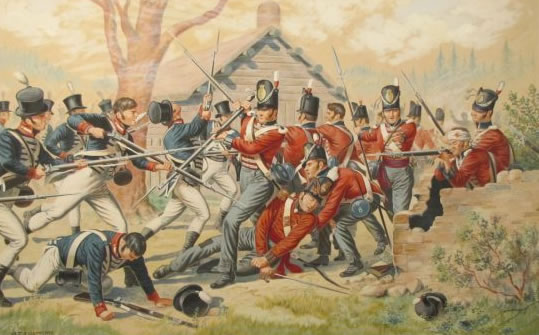
Battle of York - April 27, 1813 |
|
The Battle of York, which would later be called the Battle of Toronto, was classified as a Pyrrhic American victory. A Pyrrhic victory is a victory that comes at a great cost, such as a large number of casualties or loss of supplies. A Pyrrhic American VictoryAmerican forces under the combined command of Henry Dearborn, Isaac Chauncy and Zebulon Pike landed in York and immediately set out to attack Fort York. The British force of 400 soldiers under the command Roger Sheaffe had no chance to make a stand. Instead, they blew up hundreds of barrels of gunpowder in the fort and set fire to the HMS Isaac Brock (a ship). The explosion killed Zebulon Pike and caused the deaths of many soldiers. York is BurnedAfter the battle, American soldiers burned much of York. Although the Americans captured important British supplies meant for use in future battles, York was abandoned five days after the battle. A Costly American VictoryThe Battle of York, later known as the Battle of Toronto, was an American win, but it came at a high price. This kind of win is called a "Pyrrhic victory"—it means the side that won lost a lot in the process. The Attack on YorkAmerican leaders Henry Dearborn, Isaac Chauncy, and Zebulon Pike led soldiers into York to attack Fort York. British commander Roger Sheaffe, with only 400 soldiers, knew he couldn’t win, so he blew up barrels of gunpowder and set fire to a British ship. Heavy LossesThe explosion killed American commander Zebulon Pike and many of his men. Even though the Americans took the fort, the losses made the victory very costly. Burning the TownAfter the battle, American troops burned much of York and took British supplies. However, they left the town just five days later. |