Siege of Baltimore - September 12-14, 1814 |
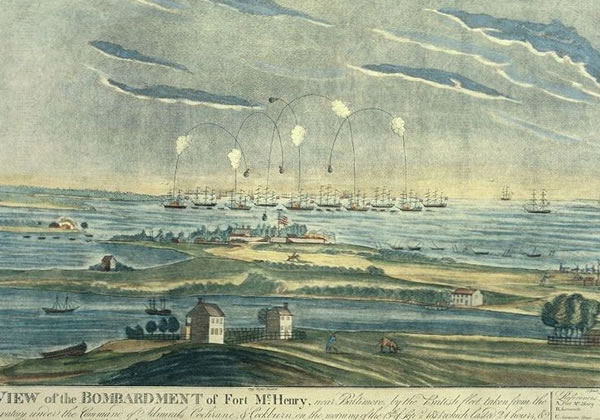
A Turning PointThe siege and bombardment at Baltimore in 1814 was the turning point in the War of 1812. After routing American forces at the Battle of Bladensburg, and subsequently burning Washington to the ground, British land and naval forces hoped to further demoralize the Americans by destroying port of Baltimore. The British Attack Baltimore HarborThe well-fortified city of Baltimore was under the command of Samuel Smith. The British initially chose to attack by land, but American defenses were much stronger than anticipated. Furthermore, British Commander Robert Ross was killed during the British excursion, and the decision to attack Fort McHenry in Baltimore Harbor was made. American forces concentrated in and around Fort McHenry to prepare to defend it against the impending attack. Before the battle, commander of the fort George Armistead, ordered the sinking of a line of American merchant ships to prevent British ships from gaining access to the harbor. The Americans Refuse to SurrenderOn the night of September 13, 1814, British naval forces began firing shells and rockets at Fort McHenry. The bombardment continued for more than 27 hours. During the bombardment, Francis Scott Key, who was a temporary British prisoner, became inspired to write the Star-Spangled Banner on the back of an envelope. He originally named his poem "Defense of Fort McHenry." When it became apparent the Americans would not surrender the fort, British forces withdrew from the region and set their sights on New Orleans. A Turning PointThe siege of Baltimore in 1814 was a major turning point in the War of 1812. After burning Washington, British forces wanted to hurt American morale even more by attacking the important port city of Baltimore. The British Attack Baltimore HarborBaltimore was protected by strong defenses led by Samuel Smith. The British first attacked by land but were surprised by how strong the American defenses were. British commander Robert Ross was killed, so they decided to attack Fort McHenry instead. To block the harbor, American commander George Armistead had ships sunk to stop the British navy from sailing in. The Americans Refuse to SurrenderOn the night of September 13, 1814, the British navy bombed Fort McHenry for over 27 hours. During the attack, Francis Scott Key, who was being held by the British, wrote a poem that later became the U.S. national anthem, “The Star-Spangled Banner.” When the British saw that the Americans would not give up, they left and moved on to attack New Orleans. |