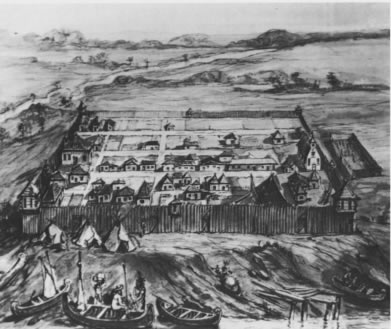
Surrender at Fort Detroit - August 16, 1812 |
We took Fort Mackinac, Why Not Fort Detroit?The surrender of Detroit was a humiliating loss for the Americans at the start of the War of 1812. After Isaac Brock and British forces took Fort Mackinac, Brock decided to make an attempt at Fort Detroit near the western edge of Lake Erie, which was occupied by the Americans under William Hull. Hull had plans to raid the British fort at Amherstburg, but elected to retreat to Fort Detroit after the defeat at Fort Mackinac. Hull is Outsmarted; Surrenders the FortBrock, along with the native chief Tecumseh, formulated a plan in which they made their small force seem much larger than it was by lighting many fires and lining troops in strategic formations. Fearing an onslaught, and completely fooled by the British, Hull quickly surrendered the entire fort, including 39 cannons and 2,500 muskets. Two large detachments of soldiers were also surrendered. The American defeat prevented them from invading Canada and gave the British a stronghold in Michigan. BackgroundThe surrender of Fort Detroit was a major loss for the Americans early in the War of 1812. After the British took Fort Mackinac, British General Isaac Brock aimed to capture Fort Detroit, which was controlled by American General William Hull. Hull had wanted to attack the British fort at Amherstburg but decided to go back to Fort Detroit after hearing about the defeat at Fort Mackinac. Brock’s Strategy and Hull’s SurrenderGeneral Brock and Native leader Tecumseh used a clever trick to make their small army look much larger. They built many campfires and lined up troops in ways that made them seem stronger than they were. General Hull, afraid of a big attack and fooled by the trick, surrendered Fort Detroit without a fight. He gave up 39 cannons, 2,500 muskets, and two groups of soldiers. This loss stopped the Americans from attacking Canada and gave the British control in Michigan. |