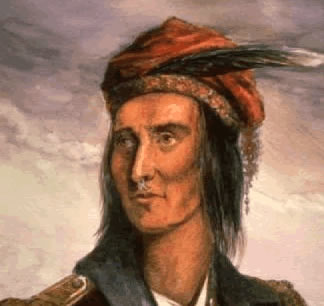
Tecumseh |
||
Warrior From an Early AgeTecumseh was born into a Shawnee Indian village sometime around in 1768 in Ohio. His name is said to mean "A Panther Crouching for his Prey" and is derived from his family clan. Tecumseh was exposed to war from a very early age. In 1774, Pukeshinwah, his father, was killed in Lord Dunmore's War (a war between Indians and settlers in Ohio). In the Revolutionary War, many Shawnee villages were raided and plundered by American frontiersmen. After the death of his father, Tecumseh accompanied his brother, a Shawnee war leader, to battles in Ohio and Kentucky against white settlers. Tecumseh also fought among the Cherokee Indians against white settlers in Georgia. Prophetstown and the ResistanceTecumseh settled in Ohio with his younger brother Tenskwatawa("The Prophet").Together, the brothers led a resistance against white settlers trying to clear them from the land. The Shawnee chief, Black Hoof, however, favored establishing a peaceful relationship with the settlers and the U.S. government. Because of this disagreement, Tecumseh and Tenskwatawa moved west and founded the village of Prophetstown near the confluence of the Wabash and Tippecanoe Rivers. Soon, Native Americans throughout the country came to Prophetstown. After various Native Indian leaders sold over 2.5 million acres of land to the U.S. Government in the Treaty of Fort Wayne, Prophetstown became a center of resistance. Tecumseh led the resistance with his powerful speeches and leadership qualities. He traveled to Native American groups throughout the land and called for the union of all. He urged individuals to abandon chiefs if they accommodated the White settlers, and join the resistance at Prophetstown. Tecumseh also warned prospective settlers not to settle on Indian land, and that the Treaty of Fort Wayne was illegitimate. The Battle of TippecanoeDuring one of Tecumseh's recruiting trips to southern lands, American General William Henry Harrison and about 1,000 soldiers marched from Vincennes, Indiana to Prophetstown for the purposes of intimidating the Indians. That night, Tenskwatawa sent his warriors to attack the encampment of American soldiers. The Battle of Tippecanoe ensued, and American forces held their ground and sent the warriors into a full-scale retreat. Prophetstown was subsequently burned to the ground. As a result of the burning of Prophetstown, and because the United States and Great Britain had begun the War of 1812, Tecumseh and his followers joined forces with the British against their common enemy - The Americans. Tecumseh's Death at the Battle of ThamesTecumseh and his warriors participated in many major battles of the War of 1812, and helped General Isaac Brock take the American stronghold at Detroit. In October of 1813, however, Tecumseh was killed in the Battle of Thames in present day Ontario, Canada. After his death, the Indian resistance quickly fell apart. Today, several towns in the United States and Canada are named after him.
Warrior From an Early AgeTecumseh was born around 1768 in a Shawnee village in Ohio. His name means "A Panther Crouching for His Prey." From a young age, Tecumseh saw war. His father died in 1774 during a battle between Native Americans and settlers. During the Revolutionary War, American frontiersmen attacked Shawnee villages. Tecumseh followed his brother, a war leader, into battles in Ohio, Kentucky, and even with the Cherokee in Georgia. Prophetstown and the ResistanceTecumseh and his brother Tenskwatawa (called "The Prophet") lived in Ohio and led resistance against white settlers. They disagreed with Shawnee chief Black Hoof, who wanted peace. So, the brothers moved and started a new village called Prophetstown in Indiana. Many Native Americans joined them. When other leaders sold 2.5 million acres of land to the U.S. in the Treaty of Fort Wayne, Tecumseh called the treaty illegal. He gave speeches asking Native tribes to unite and resist the settlers. The Battle of TippecanoeWhile Tecumseh was away gathering support, U.S. General William Henry Harrison led 1,000 soldiers to Prophetstown to scare the Native Americans. That night, Tenskwatawa sent warriors to attack the U.S. soldiers. After a hard fight, the American troops forced the Native warriors to retreat. The next day, they burned Prophetstown to the ground. Because of this and the start of the War of 1812, Tecumseh and his followers joined the British in fighting the Americans. Tecumseh's Death at the Battle of ThamesTecumseh helped the British in major battles during the War of 1812, including the capture of Detroit. But in October 1813, he was killed in the Battle of Thames in Canada. After his death, Native resistance ended. Today, many towns in the U.S. and Canada are named after Tecumseh to honor his legacy. |
||
| Tecumseh Activities | ||
|