John Wesley Powell |
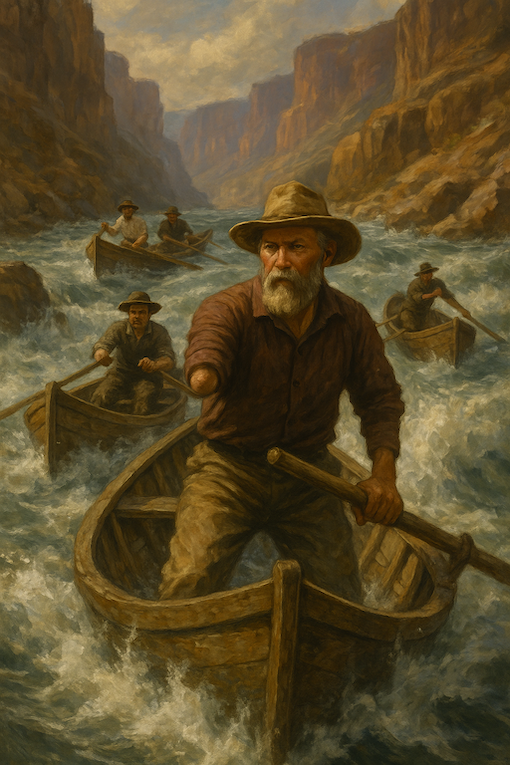
Depiction of John Wesley Powell on the Colorado River |
Early LifeJohn Wesley Powell was born on March 24, 1834, in Mount Morris, New York. His family later moved to Ohio and then Wisconsin. From a young age, Powell loved science and nature. He enjoyed collecting rocks, studying animals, and learning about rivers. Although his family was not wealthy, he taught himself a lot and later studied at different colleges. Powell was especially interested in geology and the natural world.Civil War ServiceWhen the Civil War began in 1861, Powell joined the Union Army. He became a major and lost part of his right arm at the Battle of Shiloh. Despite this serious injury, Powell returned to the army and continued to fight. His bravery showed his determination and strength.Exploration of the Colorado RiverAfter the war, Powell turned back to science and exploration. In 1869, he led a dangerous expedition down the Colorado River through the Grand Canyon. Many people thought the trip would be impossible, but Powell and his team completed it, making history. His expedition brought back valuable information about the geography, geology, and Native peoples of the region.Later Career and LegacyPowell became the director of the U.S. Geological Survey and the Bureau of Ethnology at the Smithsonian Institution. He studied Native American cultures and worked to protect natural resources in the West. Powell believed in using science to guide how land and water should be managed. He died on September 23, 1902, leaving behind a legacy as a brave explorer, scientist, and leader.Discussion Questions1. How did Powell’s childhood interests prepare him for scientific exploration?2. What does Powell’s return to duty after Shiloh reveal about his character? 3. Why did the 1869 expedition change how Americans viewed the Grand Canyon and the West? 4. Which of Powell’s ideas about water use still matter today, and why? Glossary
Five Interesting Facts
Timeline
Early LifeJohn Wesley Powell was born in 1834 in New York and grew up in Ohio and Wisconsin. He loved nature, rocks, and rivers. Even though his family was poor, he studied science and geology on his own.Civil WarPowell fought for the Union in the Civil War. At the Battle of Shiloh, he lost part of his right arm. Still, he returned to fight again, showing courage and determination.ExplorationIn 1869, Powell led an expedition down the Colorado River and through the Grand Canyon. Many thought it was impossible, but he succeeded. His trip brought back important knowledge about the land and Native peoples.Later WorkPowell later led the U.S. Geological Survey and studied Native American cultures. He warned about water shortages in the West and wanted science to guide land use. He died in 1902, remembered as a brave explorer and scientist. |