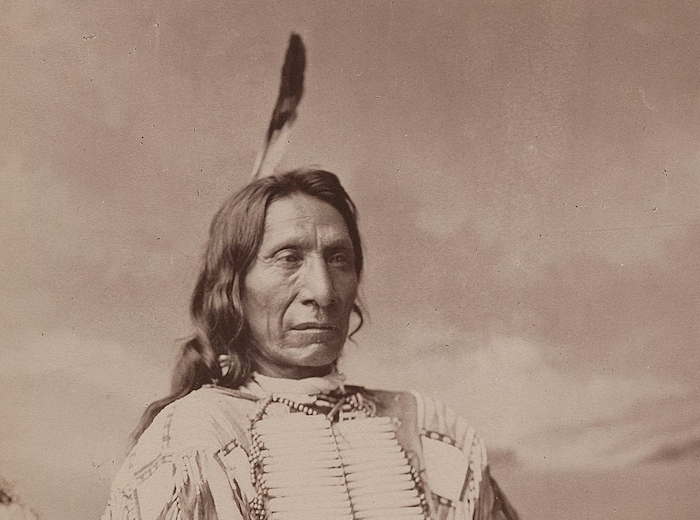
Early Life and Background
Red Cloud was born around 1822 near the Platte River in what is now Nebraska. He belonged to the Oglala Lakota, one of the seven tribes of the Lakota Sioux. From a young age, Red Cloud learned the skills of hunting, leadership, and warfare. His people relied on the buffalo for food, clothing, and shelter, and Red Cloud grew up deeply connected to the land and the traditions of his tribe. As he matured, he became known for his bravery and strong sense of justice, earning the respect of his people.
Red Cloud’s War
In the 1860s, the U.S. government began building roads and forts through Lakota land to reach gold fields in Montana. This violated treaties that promised the land to the Lakota. Red Cloud united several tribes to fight back. From 1866 to 1868, his warriors attacked U.S. soldiers and settlers in what became known as Red Cloud’s War. The conflict was one of the few times Native Americans forced the U.S. Army to abandon its forts. The resulting Treaty of Fort Laramie (1868) granted the Lakota control over the Black Hills and surrounding areas.
Life After the War
After signing the treaty, Red Cloud continued to fight for his people’s rights—this time through diplomacy. He traveled to Washington, D.C. to meet President Ulysses S. Grant and argue for better treatment of the Lakota. Though he avoided future wars, Red Cloud opposed government efforts to move his people onto smaller reservations or take more of their land. Despite his peaceful stance, the discovery of gold in the Black Hills led to new conflicts, and the U.S. broke its promises.
Legacy and Death
Red Cloud lived to see many of his people’s lands taken away, but he remained a respected leader until his death in 1909 on the Pine Ridge Reservation in South Dakota. He is remembered as one of the greatest Native American leaders—brave in war, wise in peace, and devoted to protecting his people’s way of life.
Discussion Questions
- Why did Red Cloud choose to go to war against the U.S. government?
- How did the Treaty of Fort Laramie change life for the Lakota people?
- In what ways did Red Cloud show leadership and courage?
- What lessons can we learn from Red Cloud’s efforts to defend his people’s land?
Glossary
- Oglala Lakota: A group within the Lakota Sioux tribe.
- Treaty: A formal agreement between nations.
- Reservation: Land set aside by the U.S. government for Native American tribes.
- Diplomacy: The practice of managing relations and negotiations between groups or countries.
- Fort Laramie: A U.S. military post and site of important treaties with Native American tribes.
Five Interesting Facts
- Red Cloud was the only Native American leader to win a war against the U.S. Army.
- His victory forced the U.S. government to close several forts in the Powder River region.
- Red Cloud met multiple U.S. presidents during his lifetime.
- He lived to the age of 87, witnessing major changes for Native Americans.
- Schools, towns, and landmarks have been named in his honor.
Timeline
- 1822 – Red Cloud is born near the Platte River.
- 1866–1868 – Leads Red Cloud’s War against the U.S. Army.
- 1868 – Signs the Treaty of Fort Laramie.
- 1870s – Visits Washington, D.C. to negotiate for his people.
- 1909 – Dies on the Pine Ridge Reservation, South Dakota.