Captain James Cook |
||
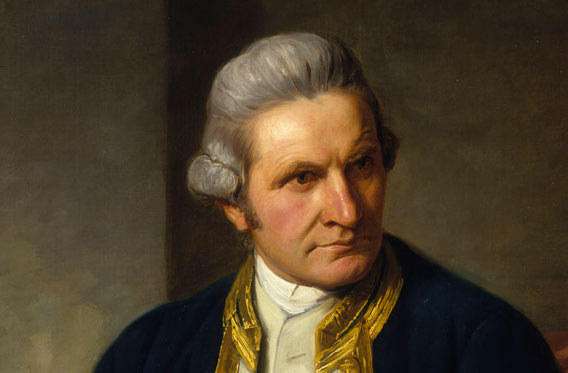 |
||
Early Life and CareerJames Cook was born October 27, 1728, in Yorkshire, England. He was the son of a Scottish farmhand. When he was about 18, he was offered an apprenticeship as a merchant seaman. Cook later joined the British navy and mastered navigation, charting, and mapmaking as a cartographer. His skills impressed those in the upper ranks of the English navy. At age 29, he was given a ship to chart Newfoundland off the coast of Canada. Unlike many explorers, Cook took measures to keep his crew healthy such as requiring daily baths, keeping the ship very clean, and bringing fresh fruit and lots of sauerkraut to prevent scurvy, which killed many sailors. Three ExpeditionsIn 1768, Cook commanded the HMB Endeavour (ship) for the first scientific expedition to the Pacific Ocean. He visited Tahiti to observe the planet Venus passing between the Earth and sun to help astronomers calculate the distance of the sun from Earth. He discovered and charted New Zealand in 1770 and landed on Australia’s eastern coast. James and his crew (some scientists among them) found interesting animals and plants, including kangaroos. Navigating the east coast of Australia was dangerous, and the ship almost sunk when it hit the coral of the Great Barrier Reef (which Cook also mapped). They stayed in Australia for almost two months repairing the ship, returning to England in July 1771. Cook’s second circumnavigation of the globe from 1772-1775 was launched to search for a fabled southern continent called Terra Australis, or, to prove it didn’t exist. He took two ships, the Adventure and the Resolution. Cook came very close to sighting Antarctica before pack ice forced him to turn back. The sailors on this expedition traveled farther south than any European explorers. Cook’s third and final voyage started in 1776. He was searching for the Northwest Passage in the Pacific Ocean with two ships, the HMS Resolution and Discovery. In 1778, he discovered the Hawaiian Islands, which he named the Sandwich Islands after the Earl of Sandwich. Because he was a British explorer on a British ship during the Revolutionary War, he was vulnerable to capture or attack by American warships. Cook, however, was so well respected that Benjamin Franklin ordered that his ships be left alone. Nevertheless, Cook sailed north all the way to the Bering Sea off of present-day Alaska, where he discovered what came to be known as Cook’s Inlet and charted much of northwestern North America. Cook then sailed into the Bering Strait where he was eventually blocked by sea ice. In 1779, Cook’s expedition returned south to the Hawaiian Islands, where hostilities arose between the expedition and the native Hawaiians. When Cook attempted to kidnap a Hawaiian chief, he was killed. LegacyJames Cook explored and mapped more territory than any navigator of his time and provided the first accurate map of the Pacific. In addition, his expedition discovered thousands of new plant species and many new animals. Artists on his expeditions rendered valuable paintings and drawings of the Pacific Islands.
Discussion QuestionsJames Cook was born on October 27, 1728, in Yorkshire, England, the son of a Scottish farmhand. He began his career as a merchant seaman before joining the British navy, where he developed exceptional navigation and mapping skills. His talents earned him command of a ship at age 29 to chart the coast of Newfoundland. Unlike many explorers of his time, Cook prioritized crew health by enforcing hygiene and bringing foods like sauerkraut and fresh fruit to prevent scurvy. Three Expeditions
In 1768, Cook commanded the HMB Endeavour on a scientific voyage to the Pacific. He observed the transit of Venus in Tahiti, then mapped New Zealand and the eastern coast of Australia, nearly losing his ship on the Great Barrier Reef. He and his crew spent almost two months in Australia making repairs and returned to England in 1771 with valuable botanical discoveries. LegacyJames Cook charted more territory than any other navigator of his era and produced the first accurate map of the Pacific Ocean. His expeditions advanced scientific understanding, contributed thousands of new plant and animal discoveries, and brought back detailed drawings and cultural observations of the Pacific Islands. |
||
| James Cook Activities | ||
|
