Ferdinand Magellan |
|||||
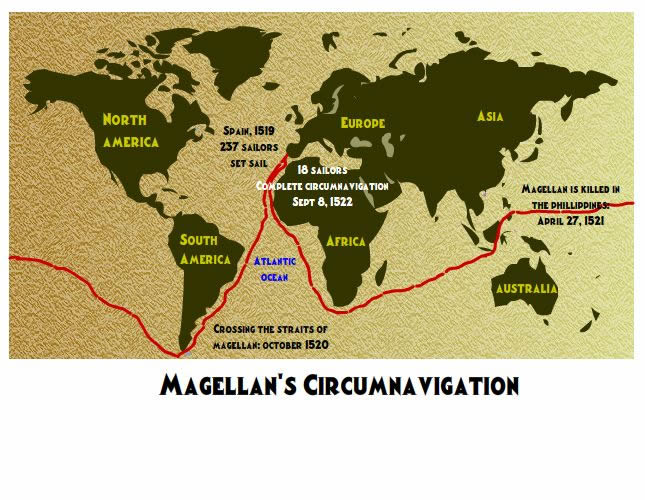
Early LifeFerdinand Magellan was born in Sabrosa, Portugal, in 1480 into a noble family. After serving as a court page for two years, his adventurous spirit led him to a career as an explorer. In 1506, Magellan went to the Spice Islands (Indonesia) to participate in several military and exploratory expeditions. In 1510, he was promoted to the rank of captain. In 1512, he was stationed in Morocco and made preliminary plans to find a western shortcut to the Spice Islands. Unfortunately, Portugal’s king, Emmanuel, refused to finance his journey, and in 1517, Magellan renounced his Portuguese citizenship. He promptly offered his services to King Charles I of Spain. Charles I agreed to finance Magellan’s trip in the hopes of becoming the king of the richest nation in the world. CircumnavigationOn September 20, 1519, Magellan and 237 crew members set sail on five ships from Sanlucar de Barrameda in the hopes of finding a shortcut to the Spice Islands. After three long months of sailing the Atlantic, Magellan and his crew anchored near Rio de Janeiro in the present-day South American nation of Brazil. After trading with local natives, Magellan and his men quickly set sail again, ever worried about the threat of Portuguese ships. As the expedition continued, the weather got worse, and several crew members were executed for trying to take over the ship. Others were starving or suffering from frostbite. As the ships neared the southern tip of South America, one ship smashed into the beach and lost all supplies. Nevertheless, in October of 1520, Magellan and his crew crossed the treacherous straits at the tip of South America, which became known as the Straits of Magellan.
Trouble in the Pacific OceanAs the expedition passed through the straits, they entered the vast Pacific Ocean. Things got worse before they got better. The crew suffered from extreme hunger and was forced to survive by eating rats, sawdust, leather, and even maggots. At least 20 men died from disease, particularly scurvy (caused by a lack of vitamin C) and starvation. On March 6, the ships finally reached land—the Pacific island of Guam. Nevertheless, the crew members were able to collect clean water and food, despite being on the alert for attacks by the natives. Soon, the crew sailed to the Philippine Islands, where they converted natives to Christianity. During an attempt to convert the native chief, Mactan, to Christianity, Magellan was wounded by an arrow that was driven through his foot by a native warrior. Mactan, who had become upset with Magellan’s insistence that he convert, ordered his warriors to attack. They killed Magellan on April 27, 1521. Most of Magellan’s crew escaped and set sail. Magellan Interactive Circumnavigation and Scavenger Hunt
Return to SpainWith the loss of their leader, Juan Sebastian del Cano took control of the ship and sailed for Spain. Only two ships and 47 men remained. Portuguese forces captured one of the ships, leaving the Victoria as the only ship left. Severe storms and Portuguese attacks battered the Victoria. As Portuguese forces bore down on the expedition near the Cape Verde Islands, del Cano was forced to continue toward Spain without supplies or rest. Finally, on September 8, 1522, the Victoria made it back to Spain with only 18 men surviving, hence completing the first circumnavigation of the world.
Discussion Questions
Early LifeFerdinand Magellan was born in 1480 in Sabrosa, Portugal, to a noble family. He began working as a court page before joining voyages to the Spice Islands. In 1512, after serving in Morocco, he started planning a route to the Spice Islands by sailing west. When Portugal’s king refused to support his plans, Magellan offered his services to King Charles I of Spain, who agreed to fund the journey. CircumnavigationOn September 20, 1519, Magellan left Spain with five ships and 237 men. They sailed across the Atlantic and stopped in Brazil before continuing south. As they neared the tip of South America, one ship crashed and some crew members mutinied. Despite hardships, the fleet passed through what is now called the Strait of Magellan in October 1520. Some sailors also witnessed St. Elmo’s Fire—a glowing light caused by electricity during storms—on their ship’s masts. Trouble in the Pacific OceanCrossing the Pacific Ocean was extremely hard. The crew ran out of food and had to eat rats, leather, and sawdust. Many died from disease and starvation. On March 6, 1521, they reached Guam and later arrived in the Philippines. After converting some locals to Christianity, Magellan was killed in battle with Chief Mactan, who opposed conversion. Return to SpainAfter Magellan’s death, Juan Sebastian del Cano took charge. Only one ship, the Victoria, survived after battles and storms. With just 18 crew members remaining, the Victoria finally reached Spain on September 8, 1522—completing the first voyage around the world. |
|||||
| Learn More | |||||
| The Horrors of Scurvy | |||||
| The Sick Ship - Diagnosing Sailors During the Age of Exploration | |||||
| Ferdinand Magellan Activities | |||||
|
|||||