John Cabot |
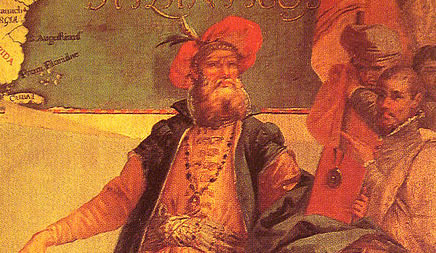 |
Early LifeJohn Cabot was most likely born in Italy, some time around the year 1450. In Italy, he is referred to as Giovanni Caboto. Not much is known about his early life except for the fact that he became a Venetian citizen (resident of Venice) in 1476. In the 1480s, he married a woman named Mattea and had three sons. In the 1490s, he apparently moved to Spain and then England, at least in part, to escape debt accrued in Italy. Sailing West to Reach the IndiesAfter the Columbus discovery of the West Indies, Cabot began formulating a plan to reach “the Indies” by sailing west at a more northerly latitude, where the voyage from Europe would be shorter. Historians believe that Cabot found supporters in the English city of Bristol, which was the second-largest seaport in England. In 1496, he made Bristol the headquarters for his seafaring operations and began to make preparations for a journey across the ocean. Exploring Eastern CanadaCabot probably first set sail in 1496, though this first voyage proved unsuccessful and Cabot turned back to England. In 1497, Cabot is thought to have set sail again with his son Sebastian and seventeen other crew members. This time, his voyage was successful. One of the boats under his command, the Matthew, sighted land and probably landed on Labrador, Newfoundland, or Cape Breton Island in modern-day eastern Canada on June 24, 1497, after 52 days at sea. Cabot claimed this land for England. Cabot continued to explore the maritime region of Canada and thought he found part of Asia, but he never found the famed Northwest Passage. Way Off CourseCabot and his crew quickly sailed back to England, where he was welcomed as a hero. Cabot promised Henry VII that the land he found was full of silk and spices, and that the land he discovered was close to Japan. The king was easily convinced to finance Cabot’s next journey, which set sail in 1498. This expedition was outfitted with two ships and 300 men. Sailing west from Bristol, the expedition pushed north along the coast of Greenland. The farther north they sailed along the coast, however, the colder it became and the larger the icebergs were. Cabot’s crew mutinied and he was forced to navigate to the south, where no new discoveries were made. Cabot and his crew returned in England in the fall of 1498 and he died shortly thereafter.
John Cabot and Henry Hudson Route Maps Discussion QuestionsJohn Cabot, born Giovanni Caboto around 1450 in Italy, later became a citizen of Venice in 1476. Little is known about his early years, but he married a woman named Mattea and had three sons. In the 1490s, he moved to Spain and then England, partly to escape debts he had accrued in Italy. Sailing West to Reach the IndiesInspired by Columbus’s voyages, Cabot developed a plan to reach Asia by sailing west on a more northern route, which he believed would be shorter. In 1496, he settled in Bristol, England’s second-largest port at the time, and began preparations for his own transatlantic expedition. Exploring Eastern CanadaAfter an unsuccessful first voyage, Cabot set sail again in 1497 aboard the Matthew with his son Sebastian and a small crew. On June 24, 1497, they sighted land—likely Labrador, Newfoundland, or Cape Breton Island—and claimed it for England. Cabot believed he had reached the outskirts of Asia, though he failed to find the Northwest Passage. Way Off CourseCabot returned to England a hero and convinced King Henry VII that he had found rich lands near Japan. A second, larger voyage was launched in 1498 with 300 men and two ships. Sailing north along the coast of Greenland, the expedition encountered extreme cold and icebergs. After a crew mutiny, Cabot turned south, made no new discoveries, and returned to England later that year. He died shortly afterward, likely in 1498 or 1499. |
| John Cabot Activities |
|