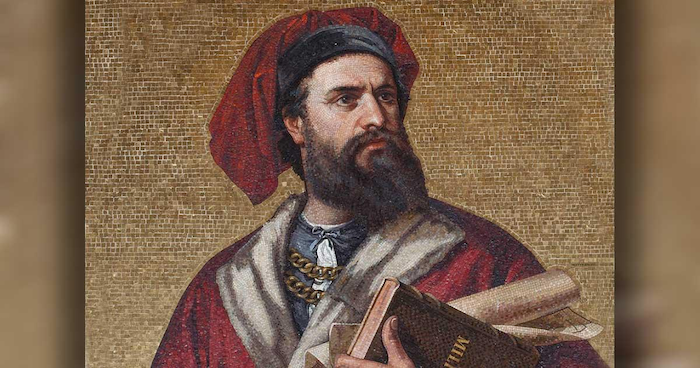
Marco Polo |
||||
IntroductionMarco Polo was born in Venice, Italy on September 15, 1254. His father and uncle were prosperous merchants who already begun trading with Chinese and Eastern merchants. Because of the constant threat of war, the Polos left Venice and eventually settled in what is now Uzbekistan. The move east to Uzbekistan made trading with China and the East much easier. In 1264, Marco's father Nicolo, and uncle, Maffio set out on a two-year long journey to meet Kublai Khan, the emperor of China in what is now Beijing. According to the account of Marco Polo, Kublai Khan received them well and requested they come back to teach the Chinese people Christianity and western customs.
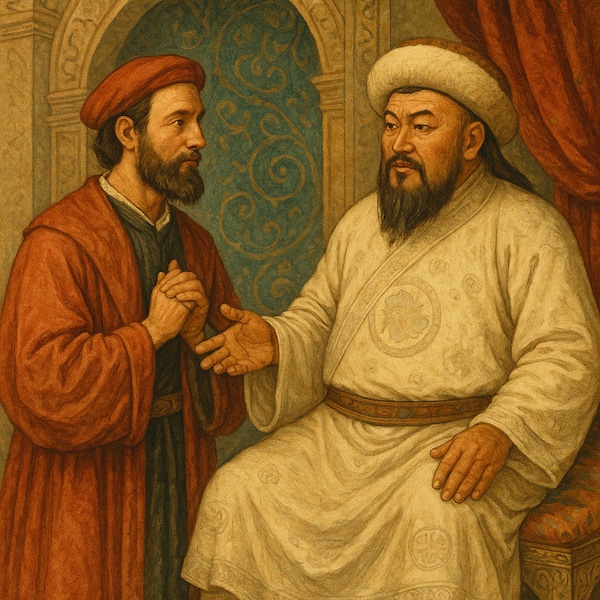
Depiction of Marco Polo with Kublai Khan Marco Polo's Descriptions of China and the Silk RoadIn 1271, the Polos set out to return to China. This time, they took Marco with them. The four year voyage across western and central Asia was long and arduous. After traveling by sea to the Persian Gulf, the Polos were forced to take an ancient caravan route through present day Iraq, Iran, and Turkmenistan. They then traversed the desolate Gobi Desert, and made their way through several ancient mercantile cities. In the spring of 1275, the Polos finally reached Shangdu, the summer residence of Kublai Khan. The route taken by the Polos became known as The Silk Road. Kublai Khan and his royal court immediately took a liking to Marco and appointed him commissioner in the Mongol government. In the meantime, Marco studied the native languages and culture. Marco soon became a trusted advisor to Kublai Khan and began recording his observations of the great ruler and his vast territories, palaces, arms, and riches. Marco described the vast Asian trading network and, in particular, the thriving silk, iron, and salt industries. He also described the foreign concept of paper money as well as Chinese inventions such as porcelain pottery (China). Marco wrote that Khan's city (known as Cambuluc) was the most fantastic city in the world. When Marco's descriptions reached Europe, a new generation of explorers was born who imagined amazing fortune for themselves in the East. Marco remained with Kublai Khan for seventeen years and recorded his observations throughout China. His recordings of a culture completely unknown in Europe proved priceless. Interactive Silk Road and Scavenger Hunt
Discussion Questions
IntroductionMarco Polo was born in Venice, Italy, in 1254. His father and uncle were successful merchants already trading with the East. To improve their trading opportunities, the family moved to what is now Uzbekistan. In 1264, Marco's father and uncle traveled to China and met the emperor, Kublai Khan, who asked them to return with knowledge of Christianity and Western customs. Marco Polo's JourneyIn 1271, the Polos returned to China, this time taking young Marco with them. Their journey took four years and passed through Iran, Iraq, and the Gobi Desert. In 1275, they reached the emperor's summer palace in Shangdu. This route later became known as the Silk Road. Life in ChinaMarco impressed Kublai Khan and was given a government position. He learned local languages and studied Chinese culture. He observed the cities, industries, and customs of the region and became a trusted advisor to the emperor. What Marco Polo SawMarco described major industries like silk, iron, and salt. He introduced Europeans to inventions like paper money and porcelain pottery. He said the emperor’s city of Cambuluc (now Beijing) was the most amazing in the world. His accounts inspired future explorers and opened European minds to Asia.
|
||||
| Marco Polo and the Silk Road Activities | ||||
|
||||