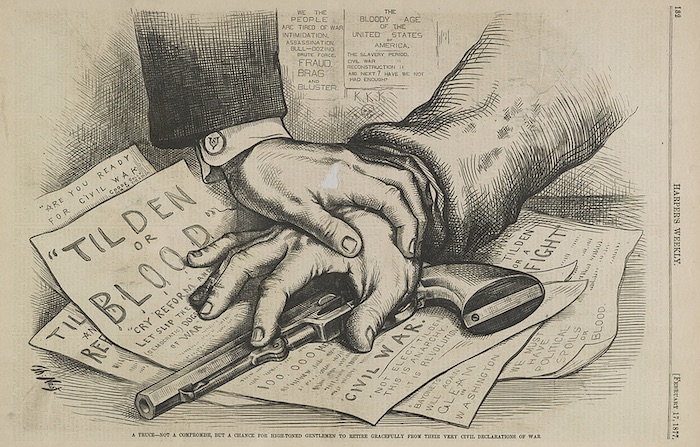
Compromise of 1877 |
|
Introduction to the CompromiseThe Compromise of 1877 was a political agreement that ended the disputed 1876 United States presidential election between Republican Rutherford B. Hayes and Democrat Samuel J. Tilden. The election was highly contested, with both sides accusing the other of voter fraud and irregularities. Context and Political ClimateAt the time, the United States was still recovering from the Civil War and Reconstruction, and the political climate was highly charged. Tilden won the popular vote and had the lead in the Electoral College, but there were disputed results in several southern states, including Florida, Louisiana, and South Carolina. The outcome of the election hinged on the results of these states, and the dispute dragged on for several months. Resolution Through a CommissionTo resolve the impasse, a bipartisan commission was formed to investigate the disputed results. The commission consisted of five members of Congress, five Supreme Court justices, and five members of the Cabinet. The commission ultimately ruled in favor of Hayes, awarding him the disputed electoral votes in the southern states and giving him the presidency. The Political DealThe Compromise of 1877 was the result of a political deal struck between the Republicans and Democrats. In exchange for Hayes being awarded the presidency, the Republicans agreed to withdraw federal troops from the southern states, effectively ending Reconstruction. This compromise led to the establishment of Jim Crow laws in the South and the disenfranchisement of African American voters for many years. Long-Term ImpactThe Compromise of 1877 had a profound impact on American politics and society. It effectively ended the Reconstruction era and paved the way for the rise of segregation and discrimination against African Americans in the South. The compromise also demonstrated the willingness of political leaders to prioritize their own interests over the well-being of the country and its citizens. Discussion Questions
The Disputed ElectionThe Compromise of 1877 ended a very close and disputed presidential election between Republican Rutherford B. Hayes and Democrat Samuel J. Tilden. Both sides claimed some votes were not fair, and the results in several southern states were unclear. Political TensionThe country was still healing from the Civil War and Reconstruction. Tilden won the popular vote and led in the Electoral College, but results from Florida, Louisiana, and South Carolina were argued over for months. How It Was SettledA special commission with members from Congress, the Supreme Court, and the Cabinet was formed to decide the outcome. The commission gave the disputed electoral votes to Hayes, making him the next president. The Compromise and Its EffectsIn return for Hayes becoming president, Republicans agreed to remove federal troops from the South. This ended Reconstruction and led to many new laws that took away rights from Black Americans, like Jim Crow laws. Long-Term ConsequencesThe Compromise of 1877 ended efforts to protect Black civil rights in the South. It showed how political leaders were willing to trade away justice for power and control. |