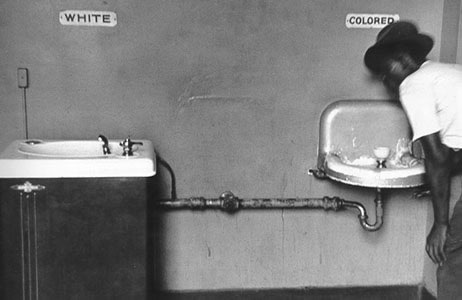
Jim Crow Laws were laws established to promote racial segregation, especially after the federal government stopped enforcing the promotion of Civil Rights in the south in 1877 (after Reconstruction).
Circumventing the New Amendments
After the Civil War, the federal government passed the 13th (prohibiting slavery), 14th (due process to all citizens), and 15th (the right to vote for all citizens) amendments, as well as The Civil Rights Acts of 1866 and 1875. These amendments and acts were specifically designed to protect the civil rights of black people. After 1877 (when the government stopped enforcing civil rights), the southern white people in power (known as Redeemers) immediately sought to take away the civil rights of black people that had been granted by twisting the language of the new laws to subjugate black people. Such laws mandated racial discrimination and became known as Jim Crow Laws (named after a racist cartoon strip of a poor, uneducated black man). Jim Crow laws came in many forms. For example, once such law required black people to "qualify" to vote by paying poll taxes, or, by reciting the entire Declaration of Independence or Constitution from memory. In 1883, the Federal Government ruled that it did not have the power to prohibit private segregation and maintained that separate facilities (including schools, restaurants, drinking fountains etc.) were constitutional provided that facilities were "equal", in the famous Plessy v. Ferguson 163 US 537 (1896) case. Of course "equal facilities" were never at all equal. Other laws required black people to sit in the back of public buses, prohibited interracial marriage, and limited employment opportunities for black people.
Legal Discrimination for the Next 100 Years
Although these laws were eventually deemed unconstitutional (most not until the 1950's and 1960's), severe racism and discrimination toward black people continued to dominate the culture of some parts of the south for seventy or eighty years.
|
Discussion Questions
- What were Jim Crow Laws, and why were they created?
- How did Southern leaders get around the 13th, 14th, and 15th Amendments?
- What was the impact of the *Plessy v. Ferguson* court case?
- Why did it take so long for Jim Crow Laws to be overturned?
What Were Jim Crow Laws?
Jim Crow Laws were rules created in the South after the Civil War to keep black and white people separated. These laws were put in place especially after the U.S. government stopped enforcing Civil Rights laws in 1877.
Getting Around the New Amendments
After the Civil War, the U.S. government passed the 13th, 14th, and 15th Amendments, which ended slavery and gave citizenship and voting rights to black people. It also passed Civil Rights laws to protect those rights. But after 1877, Southern leaders found ways to get around those laws. They made black people pay poll taxes or pass unfair literacy tests just to vote. These unfair laws became known as Jim Crow Laws.
Unequal Treatment
In 1896, a court case called *Plessy v. Ferguson* said it was okay to have separate facilities for black and white people as long as they were “equal.” But in reality, black schools and buildings were usually worse. Black people had to sit in the back of buses, couldn’t marry white people, and were often denied good jobs.
Lasting Impact
Even though most of these laws were eventually ruled illegal in the 1950s and 60s, racism and unfair treatment continued in many Southern communities for decades. Jim Crow Laws affected the lives of black Americans for nearly 100 years.
|