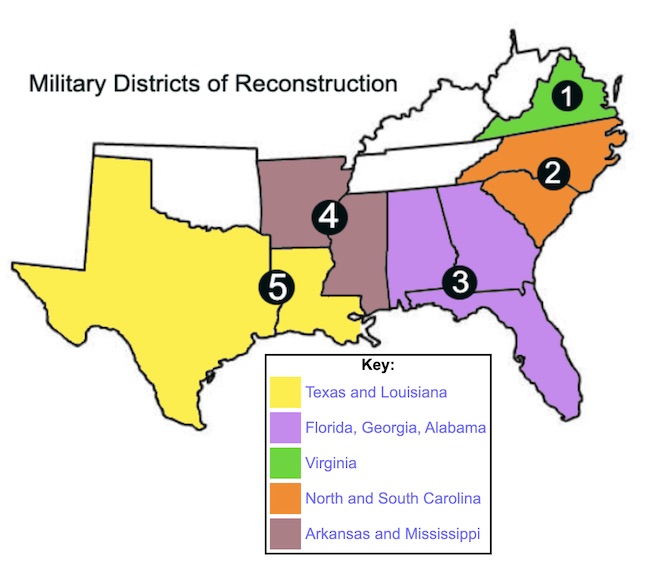
Following the end of the American Civil War in 1865, the United States entered a period of Reconstruction. This era aimed to rebuild the country and address the social, political, and economic issues that had led to the conflict. One of the key tools used to carry out this reconstruction was the establishment of military districts in the South.
Control over the Former States
The military districts were established by Congress in 1867 as part of the Reconstruction Acts. These acts aimed to impose federal control over the former Confederate states and ensure that they complied with the requirements of Reconstruction. The military districts were created in Virginia, North Carolina, South Carolina, Georgia, Florida, Alabama, Mississippi, Louisiana, and Texas. Each district was under the command of a military officer, who had the power to enforce federal law and oversee the implementation of Reconstruction policies.
Controversy
The establishment of military districts was controversial, and there was significant opposition from Southern states and Democrats in Congress. However, supporters of the districts argued that they were necessary to ensure that the rights of African Americans were protected and to prevent a resurgence of Confederate sympathies.
Crucial for the Rebuilding the South
The military districts were in place from 1867 until 1870. During this time, they played a crucial role in ensuring that the goals of Reconstruction were achieved. The military officers in charge of the districts oversaw the registration of voters, the establishment of new state governments, and the enforcement of civil rights laws. They also worked to rebuild the Southern economy and infrastructure, including schools, roads, and railroads.
Bitterness and Corruption
However, the military districts were not without their problems. Many Southerners resented the federal presence and saw it as an infringement on their states' rights. There were also issues with corruption and abuse of power by some military officers. As a result, there were calls to end the military districts and return control of the South to civilian authority.
Enforcement Acts
In 1870, Congress passed the Enforcement Acts, which gave federal authorities greater powers to combat the Ku Klux Klan and other groups that were working to undermine Reconstruction. The same year, the military districts were dissolved, and control of the South was returned to civilian authority. However, Reconstruction would continue for several more years, with mixed success. |