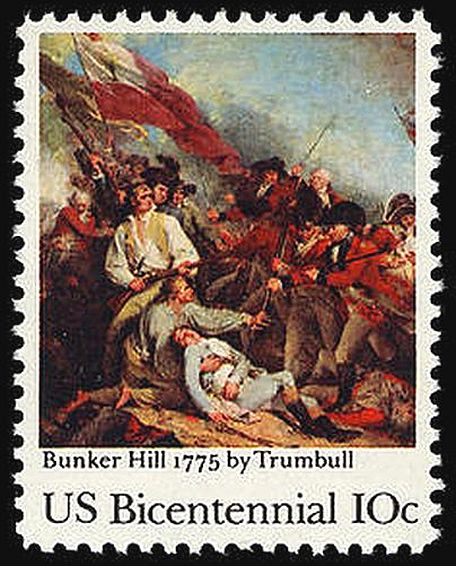
The Battle of Bunker Hill |
|
Following the Battle of Lexington and Concord, Patriot militiamen had blocked the British from sending reinforcements or supplies to their forces within the city by land. The British, however, could still access Boston through its harbor. On May 25, 1775, British generals William Howe, John Burgoyne, and Henry Clinton arrived in Boston via its harbor to plan strategy for breaking the siege. Part of the plan called for the fortification of high ground around Boston that included Bunker Hill and Dorchester Heights.
Fortifying Bunker and Breed's HillsOn June 15, Patriot forces learned of the British plan and rushed to fortify both Bunker and Breed's Hill on the Charlestown Peninsula before the British. The Charlestown Peninsula was a narrow strip of land that extended about a mile into Boston Harbor. In preparation for the battle, the British generals underestimated the resolve of the Patriots and voted to stage a direct assault on the Patriots to dislodge them from the hills for the purposes of taking the peninsula. General Burgoyne, in fact, referred to the militia as “untrained rabble.” Costly British VictoryAt 3:00 in the afternoon on June 17, the British began their initial assault on Breed's Hill, which was summarily repulsed by Patriot gunners. With the British marching four men deep and several hundred across, they made for easy targets and hundreds fell dead or wounded in the matter of hours. The British reorganized and again attempted to assault the Patriot position, but the outcome was much the same as the first disaster. By this time, the armies of both sides were in disarray. The British, however, reorganized for a third assault, which was designed to focus on the fortifications of Breed's Hill. Again, Patriots gunners poured gunfire into the British lines, felling hundreds. As the fighting went on, however, the Patriots on Breed's Hill ran out of ammunition which invited hand-to-hand combat inside the fortifications. Here, the British had a major advantage with their muskets and bayonets. At this point, the Patriots were forced to flee and staged a brilliant retreat, preventing most soldiers from being captured by the British. Despite the carnage, however, the British had achieved their objective of controlling the Charlestown Peninsula. The Battle of Bunker Hill is considered a pyrrhic British victory. "Pyrrhic" means costly. British forces suffered well over 1,000 casualties, compared to about 450 Patriot casualties. Of the British casualties, 81 were officers. Strategic AdjustmentFollowing the Battle of Bunker Hill, British generals proved more cautious in their approach to assaulting fortified Patriot positions. It also led to the realization that the British would need more military firepower, and hence, led to the hiring of more than 30,000 Hessian (German) soldiers to supplement their own army. For the Patriots, the stand at Bunker Hill increased confidence and morale and proved that its untrained militias would not wither against the powerful British army. After the battles of Lexington and Concord, Patriot militias blocked British forces in Boston from getting supplies by land. But the British could still reach Boston by sea. On May 25, 1775, British generals William Howe, John Burgoyne, and Henry Clinton arrived by ship to help plan a way to break the siege. Part of their plan included taking control of the high ground around Boston, such as Bunker Hill and Dorchester Heights. Fortifying Bunker and Breed’s HillsOn June 15, the Patriots found out about the British plan and quickly moved to build defenses on Bunker Hill and Breed’s Hill, located on the Charlestown Peninsula. This land stuck out into Boston Harbor. The British didn’t expect much from the Patriot forces and decided to launch a full attack to push them off the hills. General Burgoyne even called the Patriots “untrained rabble.” The Battle BeginsAt 3:00 PM on June 17, the British attacked Breed’s Hill. The Patriots fought back strongly, and many British soldiers were killed or wounded. The British tried again and again, but were pushed back each time. On the third attempt, the British focused on Breed’s Hill. Even though the Patriots fired many shots, they eventually ran out of ammunition. This led to hand-to-hand fighting, where the British had an advantage with bayonets. The Patriots retreated but avoided being captured. A Costly British VictoryThe British took control of the Charlestown Peninsula, but at a high cost. They lost over 1,000 men, including 81 officers, while the Patriots lost about 450. The Battle of Bunker Hill is called a “pyrrhic victory” for the British, meaning it was a win, but one that came with great losses. |
| Bunker Hill Activities |
|