Opportunity Strikes?
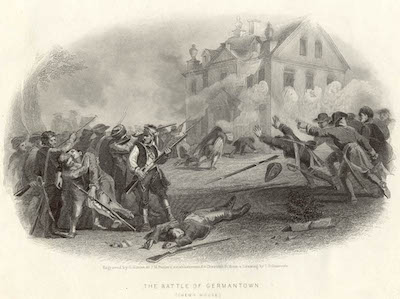
In October 1777, the Patriot effort was once again on "life support." The British had taken over Philadelphia after the Battle of Brandywine Creek, and the Americans were desperate for a victory. When George Washington heard that British General Sir William Howe was splitting up his troops, putting 9,000 men in the small town of Germantown, he saw an opportunity for an American strike. Washington knew there were four roads leading to Germantown, so he planned a four-pointed strike with his men approaching the city in all directions for a surprise attack.
Learn more about the Battle of Brandywine Creek
The Plan
The night of October 3, Washington divided his men up and ordered them to attack the city from multiple directions at dawn. General John Sullivan led the main force going in from the front, General Nathanael Greene led forces going from the side, and a militia under William Smallwood planned to go in from the right and from behind. Washington's plan was strategic and well-intentioned, but it had one flaw: planning a four-way attack requires precise communication and timing.
Unexpected Obstacles
The morning of the attack, Sullivan's group made first contact with the British and moved in towards the center of the army. However, an unforeseen variable came into play: a heavy fog set in, making it hard for parts of the army to see each other. One of Sullivan's groups, led by Anthony Wayne, was separated due to the fog. As the men started to run low on ammunition, Wayne's group heard the decreasing fire and thought that they had been cut off, withdrawing from the fight. Meanwhile, Greene's troops arrived on the scene, but one group from the squadron also got separated in the fog. Looking for the rest of the army, the group stumbled upon the group from Wayne's army and mistook them for the British enemy. Both groups began firing on each other, causing even more confusion. Finally, both units fled.
Is the Tide Beginning to Turn?
The Battle of Germantown was yet another British victory with staggering consequences for the Continental Army: 700 men were killed, and 400 were captured. Luckily, the darkness at night and the army's weaponry helped them retreat from Germantown. While the Americans were still searching for their big victory, eyes were turning to the United States from across the sea: countries in Europe, including the French, began to notice the army's dedication and perseverance. Furthermore, Howe's attack on Philadelphia left units under Burgoyne vulnerable in New York state, which led to the monumental Patriot victory at Saratoga just a few days later. Following the battle, Washington withdrew his army to winter quarters at Valley Forge.