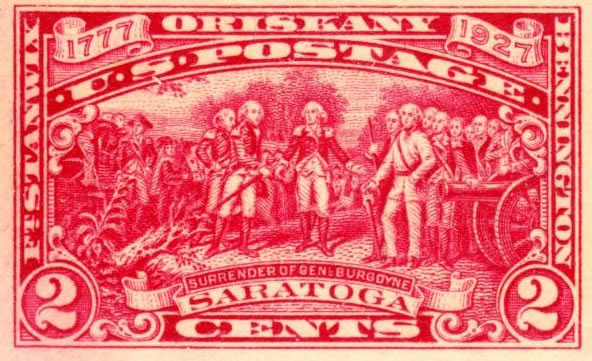
The Battle of Saratoga |
|
In 1777, British war generals devised a plan to bring a quick end to the war: They would effectively sever New England from the rest of the colonies by taking control of New York City, Albany, and the Hudson River. First, British General John Burgoyne would lead 8,000 troops from Canada. Barry St. Leger would direct his troops east from Lake Ontario, and General Howe would move his troops north from New York City, where all three would meet at Albany to destroy the Rebel armies. Major Problems for the BritishGeneral Howe, however, had different plans. Howe brought his army south from New York and invaded the Patriot capital of Philadelphia. Although he succeeded in capturing the city and forcing Congress to flee to York, Pennsylvania, he decided to camp his army in the capital for the winter, rather than proceeding with the plan and marching to Albany. Furthermore, stubborn Patriot resistance under the infamous General Benedict Arnold kept St. Leger from making it to Albany, and Burgoyne's progress was slowed by excess baggage and entire groves of trees felled by the Patriots to make his travels even more difficult. Slow on supplies, Burgoyne sent a detachment to capture an American supply base at Bennington, Vermont. The detachment was defeated by John Stark and the Green Mountain Boys, causing Burgoyne to withdraw to Saratoga, N.Y. Trapped!Burgoyne's army soon became trapped in Saratoga, blocked in the south by Patriot General Horatio Gates' army. Howe's army remained in Philadelphia, and St. Leger's Army was defeated at Fort Stanwix. On October 7, 1777, Burgoyne made a desperate attempt to attack the larger Patriot force at Saratoga which now comprised the armies of both Gates and Arnold. Despite initial success at Freeman's Farm, Burgoyne's Army would be routed by Arnold's at Bemis Heights. Beset by a lack of supplies and horrendous casualties, Burgoyne had no choice but to surrender. Learn more about Benedict Arnold The Turning PointThe Patriot victory at Saratoga is often seen as the turning point in the war. Not only did it renew the morale of the American public, but it convinced potential foreign partners, such as France, that American could win the war, and that it might be in their best interests to send aid. In February of 1778, with the help of Benjamin Franklin and his charisma while Minister to France, the United States and France signed a treaty of alliance. As a result, France sent generals, troops, ships, supplies, and money to America to help in the war effort. France declared war on England. Spain would declare war on England in 1779.
In 1777, British generals made a plan to quickly win the war. They wanted to separate New England from the rest of the colonies by taking control of New York City, Albany, and the Hudson River. General John Burgoyne would come from Canada with 8,000 troops. Barry St. Leger would come from the west, and General Howe would come north from New York City. They planned to meet in Albany and defeat the American army. Plans Fall ApartGeneral Howe changed the plan. Instead of going to Albany, he went south and took over Philadelphia, causing Congress to flee. He stayed there for the winter. Benedict Arnold stopped St. Leger from reaching Albany. Burgoyne’s troops were slowed down by too much baggage and by trees cut down by the Patriots. He sent some soldiers to get supplies in Bennington, Vermont, but they were defeated by John Stark and the Green Mountain Boys. Burgoyne moved back to Saratoga, New York. The Battle of SaratogaBurgoyne’s army got stuck in Saratoga. General Gates blocked him from the south. St. Leger was already defeated, and Howe was still in Philadelphia. On October 7, 1777, Burgoyne tried to attack. His army won a small battle at Freeman’s Farm but lost a bigger one at Bemis Heights, led by Benedict Arnold. With heavy losses and not enough supplies, Burgoyne surrendered. The Turning PointThe American win at Saratoga was a major moment in the war. It raised American spirits and proved they could win. In February 1778, with help from Benjamin Franklin, the U.S. and France signed a treaty. France sent troops, ships, supplies, and money. France declared war on Britain, and Spain joined in 1779. |
| Saratoga Activities |
|