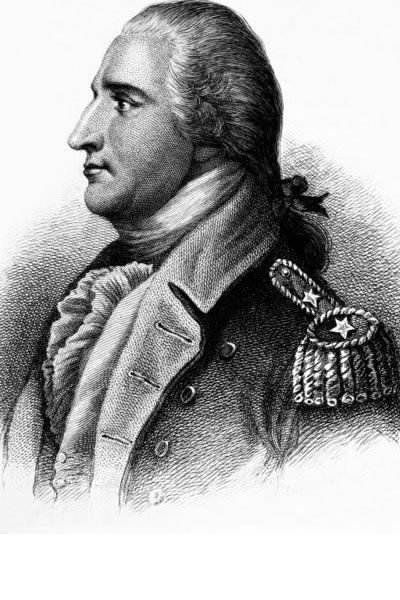
Benedict Arnold |
Benedict Arnold was born on January 14, 1741, in Norwich, Connecticut. He was one of five children, though only he and his sister survived to adulthood. While his family was fairly wealthy when he was a child, bad business decisions by his father plunged the family deep into debt. His father became an alcoholic, and Benedict was forced to drop out of school. At age fifteen, he ran away and joined the Connecticut militia, where he helped fight against the French in the Seven Years' War. After the war, Benedict's mother and father died within two years of each other.
Benedict Grows UpAfter the deaths of his parents, Benedict moved to New Haven and helped restore the family’s good name. He became a successful and enterprising pharmacist and soon made enough money to partner with a friend to buy three trading ships. Benedict and his partner established a profitable West Indies trade, and he often traveled throughout the Western Hemisphere conducting his business. In 1767, Benedict married Margaret Mansfield. The couple had three sons together, but Margaret died in 1775. Fort TiconderogaIn 1775, Connecticut was stirring with the idea of revolution. Benedict Arnold was chosen captain of the Governor’s Second Company of Connecticut Guards. The guards joined the revolution after the Battles of Lexington and Concord and marched to Massachusetts. On the way, Benedict formulated a plan to seize Fort Ticonderoga (in New York) and its cannons for the fledgling Continental Army. He convinced the Massachusetts Committee of Safety to fund the expedition and was named colonel in the Massachusetts militia. On May 10, 1775, Benedict, along with Ethan Allen, led a successful raid and occupation of Fort Ticonderoga. They also seized Fort George and Crown Point. The raids yielded much ammunition for the Continental Army. At least 100 cannons were transported all the way back to Boston for the purposes of defending the city. Nevertheless, while he was in command of the forts, the Continental Congress sent Benjamin Hinman to take command from him. Benedict started to feel unappreciated. Read more about the Seizure of Fort Ticonderoga SaratogaAfter an unsuccessful raid on the city of Quebec, Benedict was promoted to brigadier general, though he was passed over for other promotions (which fueled his resentment). Nevertheless, he played a pivotal role in preventing the escape of British General John Burgoyne and his soldiers in the 1777 Battle of Saratoga. The battle, which historians agree was the turning point of the war, helped convince French forces to team up with the Patriots to defeat the British. Benedict, however, was deprived of credit for his part in the battle because of personal disputes with Major General Horatio Gates. Learn more About the failed raid at Quebec | Learn more about the Battle of Saratoga TreasonBy 1780, Benedict was very bitter toward the Continental Congress. Appointed as the commander of the fort at West Point, New York, he offered to hand it over to British forces for a large sum of money. Arnold’s plan, however, was discovered, and he quickly swore allegiance to the British. He commanded British forces in several small-scale battles, but they would soon back out of the war, much to his contempt. By 1783, America was free and Benedict could never go back. Ironically, Benedict Arnold was also passed over for several promotions in the British Army because he was not trusted. In the years after the war, he made many unwise business decisions in England and in Canada. He died in 1801, virtually penniless. He is said to have prayed to God for forgiveness for betraying the Patriot cause in the moments before his death. He is even said to have requested to be buried in the uniform of a Continental soldier. He is buried in England. Read more about Benedict Arnold's Treason
Tainted LegacyToday, Benedict Arnold is the most famous traitor in American history. Despite his brilliance as an American general, he will be forever remembered as the man who gave the British the fort at West Point.Benedict Arnold was born on January 14, 1741, in Norwich, Connecticut. He was one of five children, but only he and his sister lived to adulthood. His family was once wealthy, but his father made poor decisions, went into debt, and became an alcoholic. Benedict had to leave school and, at 15, joined the Connecticut militia to fight in the Seven Years' War. His parents died soon after the war. Benedict Grows UpAfter his parents died, Benedict moved to New Haven. He became a successful pharmacist and businessman. He partnered with a friend to buy trading ships and made money trading in the West Indies. In 1767, he married Margaret Mansfield. They had three sons, but she died in 1775. Fort TiconderogaIn 1775, Benedict became captain of the Connecticut Guards, who joined the fight after the Battles of Lexington and Concord. He planned a mission to take Fort Ticonderoga and convinced Massachusetts to support it. On May 10, 1775, he and Ethan Allen led a successful raid and took Fort Ticonderoga, Fort George, and Crown Point. The raids gave the Continental Army over 100 cannons. But soon, Benedict was replaced by Benjamin Hinman, which made him feel unappreciated. SaratogaBenedict failed in a raid on Quebec but was promoted to brigadier general. He was still passed over for higher ranks, which made him angry. In 1777, he helped stop British General Burgoyne at the Battle of Saratoga, a key moment in the war. This helped bring France into the war on the American side. However, he didn’t get credit because of a dispute with General Horatio Gates. TreasonBy 1780, Benedict was bitter toward Congress. He was in charge of West Point and tried to give it to the British for money. His plan was discovered, and he joined the British army. He led some small attacks for them, but the war soon ended. The British also didn’t trust him and didn’t promote him. After the war, he failed in business and died in 1801, poor and regretful. He may have asked to be buried in a Continental uniform. He is buried in England.
Tainted LegacyToday, Benedict Arnold is remembered as America's most famous traitor. Even though he was a skilled general, he is known for trying to give away West Point to the British. |
| Benedict Arnold Activities |
|