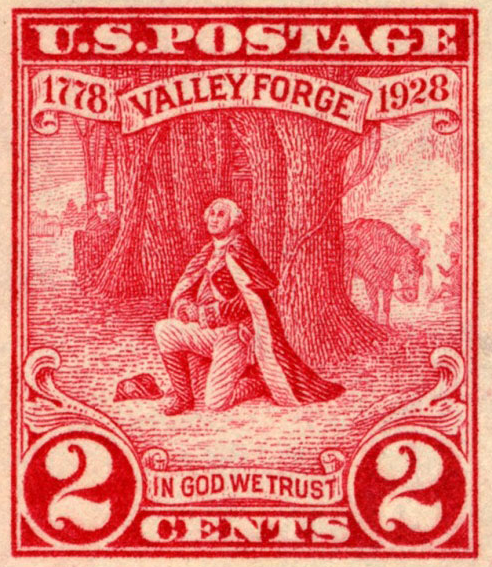
During the 1700s and 1800s, major fighting during wars generally ceased for the winters and armies took up winter encampments. As winter descended upon Pennsylvania in 1777, General George Washington chose Valley Forge, Pennsylvania, some eighteen miles west of Philadelphia as site of the winter encampment of the Continental Army. The area was far enough away from the British in Philadelphia to discourage surprise attacks and its location between high hills and the Schuylkill River made it easily defensible.
A Crumbling Army; A Brutal Winter
The Continental Army, however, was in bad shape. Of the 12,000 soldiers, many lacked the supplies or clothing to survive the winter and many others were starving at this point. At Valley Forge, defense lines were built along with over 1,000 huts to provide some relief from the brutal elements. Moisture from rain and melting snow made it impossible for many soldiers to stay dry and allowed for the spread of disease. The only reliable food that the soldiers received was a mixture of flour and water known as “firecake.” Occasionally, soldiers received meat and bread. Furthermore, many soldiers had inadequate supplies of clothing and were forced to endure the winter in tatters and without blankets. Many lacked shoes. Wounded soldiers often died from exposure to the elements. Unsanitary and crowded conditions led to the proliferation of diseases and sicknesses such as typhoid and pneumonia. Over 2,000 people died from such sicknesses.
Baron Von Steuben
On February 23, 1778, former German General Baron von Steuben arrived at Valley Forge to train the Patriots how to march in formation, fire guns quickly, use bayonets and become soldiers. Though von Steuben spoke little English, he developed a training manual in French that would be translated on the grounds into English. Unlike many American generals, von Steuben worked directly with the soldiers, endearing him to the thousands suffering at Valley Forge. Von Steuben’s presence did much to improve the morale of the army during the bitter winter and also helped them develop into a more tactical, effective military machine, capable of fighting the British.
Onward
On June 19, 1778, the Continental Army left Valley Forge in pursuit of the British who were moving north to New York.