Boston Massacre |
||||||||||
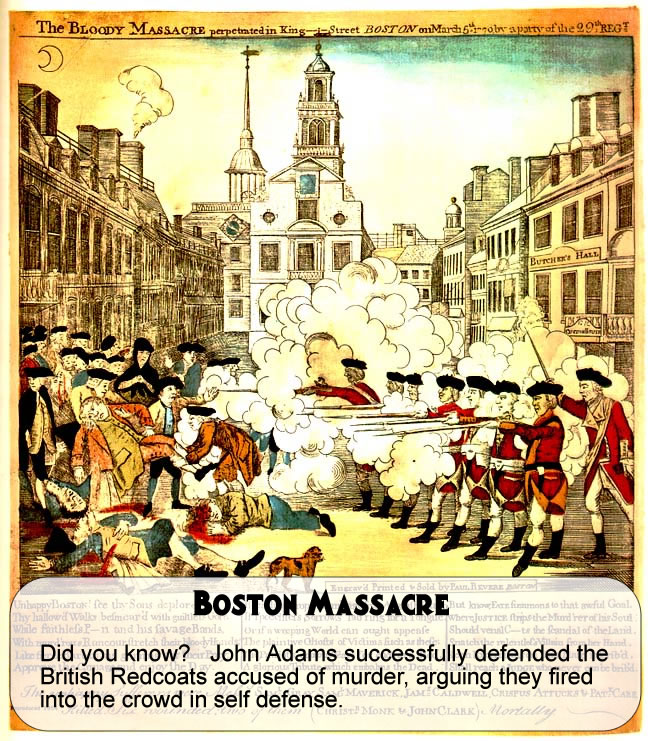
Power Point Presentation | Detailed Lesson Plan | Learn more about Paul Revere's controversial woodcut above |
||||||||||
Unrest in BostonThe situation in Boston grew more tense by the day. Local skirmishes between townspeople and British soldiers (Redcoats) increased in frequency as did belligerence toward British soldiers. Rumors abounded throughout the city about possible attacks by soldiers or by the Sons of Liberty. The Match That Lit the FlameOn Monday night March 5, 1770, an American (patriot) began harassing a Redcoat named John Goldfinch standing guard. Another Redcoat nearby, named Hugh White, joined Goldfinch to defend him. White became agitated with the harassment and struck the patriot in the face with his musket. As the patriot cried out in pain, a mob of fifty or so Bostonians gathered. Goldfinch retreated to the nearby Custom House and pointed his musket toward the angry crowd. Mob MentalityThe mob began throwing chunks of ice at White and shouted "Kill him!" Meanwhile, other mobs were forming on Boston's streets. Those mobs began pelting other Redcoats with chunks of ice. British officers on the scene ordered soldiers back to their barracks, and several had to be subdued by officers to prevent them from firing into the angry crowd. The mob surrounding Hugh White, however, grew until he was surrounded by over 400 angry Bostonians. White's shouts for reinforcements were answered by British Captain Thomas Preston and several other soldiers who entered the emotional mob. The Failed Riot ActPreston tried to march the British soldiers from the Custom House back to the Main Guard, but his path was blocked by the mob of patriots. Despite his demands for the dispersal of the crowd, the mob responded with more insults and ice chunks. When the British justice of the peace tried to read the Riot Act, which would subject all members of the mob to prosecution once it was read, the mob forced him to retreat by throwing snowballs and ice chunks at him. Desperation Leads to MayhemThe mob continued to provoke the soldiers and challenged them to fire. Members of the mob grew more and more violent and began striking the muskets and bayonets of the Redcoats with clubs. Despite his attempts to prevent bloodshed, Captain Preston was losing control of his soldiers who were growing increasingly threatened by the angry mob. Suddenly, someone in the crowd hurled a club which hit British soldier Hugh Montgomery and knocked him to the ground. Montgomery rose and fired into the crowd. Hearing the shot, the mob lunged at Preston and his men, wielding their clubs at them. For the next few minutes, the scene became a chaotic battle in which Preston's men fired into the crowd to avoid being beaten. The soldiers were able to fend off the mob which soon dispersed. When it did disperse, the bodies of several patriots lay dead or wounded on the ground. Preston and his soldiers formed a defensive line with guns drawn to protect themselves from another assault. Learn more about Crispus Attucks - African-American man killed in the Boston Massacre The AftermathLater that evening, Preston and his soldiers were arrested and accused of murder. In the ensuing trial almost all were acquitted (judged not-guilty), as the deaths had occurred in self-defense. Additionally, Parliament repealed the Townshend Act, and removed all taxes except for the tax on tea. Despite the anger in Boston over the massacre, American merchants began importing British goods again and the push for independence seemed to fizzle. Learn more about John Adams | Learn more about the trial of the British soldiers. Do you know who defended them? Discussion Questions
Glossary
Unrest in BostonTension in Boston grew as local people and British soldiers (called Redcoats) began to argue and fight more often. People were angry, and many feared violence from either side. The IncidentOn March 5, 1770, a colonist started yelling at a British soldier named John Goldfinch. Another soldier, Hugh White, came to help. He hit the colonist with his musket, and a crowd quickly formed. Goldfinch ran to the nearby Custom House and pointed his weapon at the growing mob. Things Get WorseThe crowd threw ice and shouted “Kill him!” Mobs formed across the city. Hugh White was soon surrounded by over 400 people. Captain Thomas Preston arrived with more soldiers. The Riot Act FailsPreston tried to move his men away, but the angry mob blocked them. A judge tried to read the Riot Act, which could break up the crowd, but people threw snowballs at him, forcing him to leave. Shots FiredThe crowd grew louder and more violent. People hit the soldiers' weapons with sticks. When someone hit Hugh Montgomery with a club, he fell and then fired into the crowd. Other soldiers fired too. When the crowd left, several colonists were dead or hurt. After the ViolenceThat night, Captain Preston and his men were arrested and charged with murder. Most were found not guilty, since it was self-defense. Parliament also removed most taxes, except for the one on tea. For a while, things calmed down. |
||||||||||
|
||||||||||
| Boston Massacre Tools | ||||||||||
| Boston Massacre Activities | ||||||||||
|
||||||||||