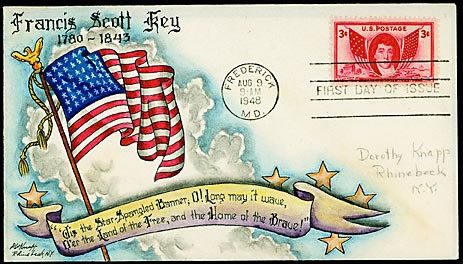
Francis Scott Key |
Early LifeFrancis Scott Key was born August 1, 1779, near Keymar, Maryland, at the family plantation known as Terra Rubra. He was a lawyer and amateur poet but only gained fame after authoring America’s national anthem – The Star-Spangled Banner. War of 1812 and British CaptureDuring the War of 1812, Key and Col. John Skinner traveled to Baltimore and negotiated the release of a prominent Maryland physician (who was arrested by the British). After the negotiation was complete, Key and Skinner were forbidden to return to Baltimore by British officials. Key and Skinner had been exposed to the British plans to bombard Baltimore (Fort McHenry). Instead, they were made to wait in the ship they came in until after the bombardment. Bombardment of Fort McHenryOn the morning of September 14, 1813, the British bombardment of Fort McHenry began. The combined sea and land assault lasted 25 hours! Wave after wave of British cannon fire and Congreve rockets were shot toward Fort McHenry. Through it all, however, the massive 30 x 42 foot flag, which flew over Fort McHenry, remained waving. The bombardment ceased on September 15 at 1:00 A.M. When daylight came, the flag was still there, and the British forces had abandoned their plan to take Baltimore. Writing the PoemInspired by the strength of the American flag, Key immediately took an envelope from his pocket and began writing a poem. He wrote more as he sailed back to Baltimore. His brother-in-law was so impressed by the poem that he began circulating copies of it around Baltimore. It was originally called “Defence of Fort M’Henry.” It soon appeared in local newspapers. National AnthemOn March 3, 1931, it officially became America’s national anthem. Below is the text from The Star-Spangled Banner. (There are actually more verses, but the verses below are the most commonly sung.) O say! can you see, by the dawn’s early light, What so proudly we hail’d at the twilight’s last gleaming? Whose broad stripes and bright stars, thro’ the perilous fight, O’er the ramparts we watched were so gallantly streaming? And the rockets’ red glare, the bombs bursting in air, Gave proof thro’ the night, that our flag was still there. O say! does that Star-Spangled Banner yet wave O’er the land of the free and the home of the brave? Early LifeFrancis Scott Key was born on August 1, 1779, near Keymar, Maryland, at his family's plantation called Terra Rubra. He was a lawyer and an amateur poet, but he became famous for writing America's national anthem – "The Star-Spangled Banner." The War of 1812 and the British BombardmentDuring the War of 1812, Key and Colonel John Skinner went to Baltimore to negotiate the release of a Maryland doctor held by the British. After the doctor was freed, Key and Skinner were not allowed to return to Baltimore because they had seen the British plans to attack Fort McHenry. They were forced to wait on their ship during the bombardment. The Bombing of Fort McHenryThe British began bombing Fort McHenry on September 14, 1813. The attack lasted 25 hours, with cannons and rockets fired at the fort. Despite the attack, the large American flag (30 by 42 feet) continued to fly. By the next morning, the flag was still waving, and the British gave up their plan to capture Baltimore. Writing the AnthemInspired by the sight of the flag still flying, Key began writing a poem on an envelope. He finished it on the way back to Baltimore. His brother-in-law was impressed and shared copies around the city. The poem, originally called "Defence of Fort M’Henry," appeared in local newspapers. Becoming the National AnthemOn March 3, 1931, "The Star-Spangled Banner" was officially named the national anthem of the United States. Below is the most commonly sung verse: O say! can you see, by the dawn’s early light, What so proudly we hail’d at the twilight’s last gleaming? Whose broad stripes and bright stars, thro’ the perilous fight, O’er the ramparts we watched were so gallantly streaming? And the rockets’ red glare, the bombs bursting in air, Gave proof thro’ the night, that our flag was still there. O say! does that Star-Spangled Banner yet wave O’er the land of the free and the home of the brave? |
| National Anthem Activities |