Benjamin Banneker |
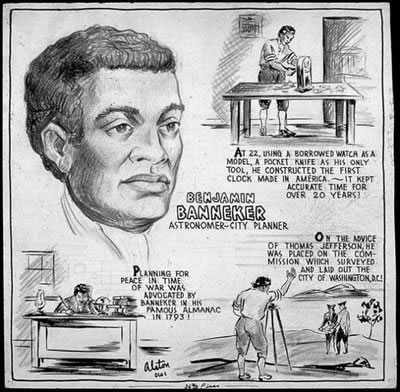
Curiosities of ChildhoodBenjamin Banneker was born on November 9, 1731, in Ellicott City, Maryland. He learned reading and math from his Quaker grandmother at an early age. Once he was old enough to help on his parents’ farm, his formal education ended. Despite this, Benjamin loved to take things apart and put them back together. At twenty-one, he received his first pocket watch. Fascinated by its design, he built his own working clock out of wood. Learning AstronomyBanneker became a clock and watchmaker. One of his customers, surveyor Joseph Ellicott, was impressed by Benjamin’s skill and lent him books on mathematics and astronomy. Even though Benjamin was fifty-eight years old, he began studying these subjects. He learned astronomy and made calculations predicting solar and lunar eclipses. Benjamin compiled these calculations in his own almanac, which included planetary positions for each day. His almanac was titled Benjamin Banneker’s Pennsylvania, Delaware, Maryland and Virginia Almanack and Ephemeris, for the Year of Our Lord, 1792. Surveying the District of ColumbiaAt fifty-nine, Banneker was hired by Andrew Ellicott, Joseph’s brother, to help survey the land that would become Washington, D.C. Illness forced him to leave early, but he sent a copy of his almanac to Secretary of State Thomas Jefferson. Correspondence with Thomas JeffersonBanneker wrote letters to Jefferson, criticizing his support of slavery and urging its abolition. Jefferson replied, agreeing with Banneker’s hopes for ending slavery. These letters were later published in copies of Banneker’s almanac. Banneker's Other ObservationsIn his surviving journal, Banneker recorded observations of the Brood X cicada in 1749, 1766, and 1783, as well as notes on honey bees and their hive behavior. LegacyBanneker died in 1806 as a pioneer in astronomy and civil rights. Sadly, many of his papers were lost in a fire on the day of his funeral. Today, a monument in Washington, D.C., is being planned in his honor.
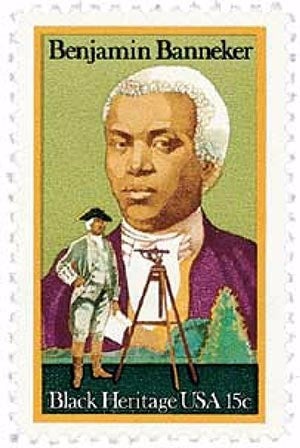
Benjmain Banneker Postage Stamp Most Famous Quote"Presumption should never make us neglect that which appears easy to us, nor despair make us lose courage at the sight of difficulties." – Benjamin Banneker Discussion Questions
Glossary
Five Interesting Facts
Timeline of Benjamin Banneker’s Life
Benjamin Banneker was born in 1731 in Maryland. He learned reading and math from his grandmother but had little formal schooling. At age 21, he built a working wooden clock after studying a pocket watch. Banneker later became a clock and watchmaker. At 58, Banneker taught himself astronomy using books borrowed from Joseph Ellicott. He predicted eclipses and wrote an almanac with daily positions of planets. In 1791, he helped survey the land for Washington, D.C., and sent his almanac to Thomas Jefferson. He also wrote Jefferson, asking him to help end slavery. Jefferson responded, agreeing in principle, and their letters were published in Banneker’s almanac. Banneker died in 1806, and most of his papers were lost in a fire. He is remembered as an important African American scientist and civil rights advocate. Benjamin Banneker Video - YouTube |
| Benjamin Banneker Activities |
|