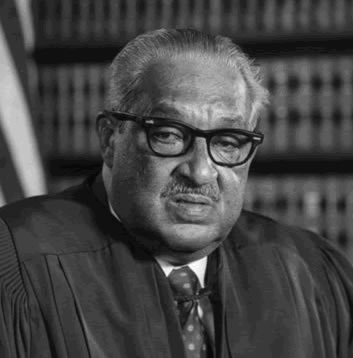
Thurgood Marshall |
Early Life and EducationThurgood Marshall was born on July 2, 1908, in Baltimore, Maryland. His interest in the U.S. Constitution began early when he was punished by being required to read it in second grade. Marshall graduated from Lincoln College in 1930 but was denied admission to the University of Maryland Law School because he was Black. Instead, he attended Howard University Law School in Washington, D.C., graduating in 1933. Soon after, he opened his own law practice in Baltimore. First Major Legal VictoryIn 1934, Marshall won his first major case when he represented Donald Gaines Murray, a Black Amherst College graduate who was denied admission to the University of Maryland Law School under its "Separate but Equal" policy. Marshall argued that the alternative schools were not equal and lacked law programs. The judge ruled in favor of Marshall, striking a blow against educational discrimination. NAACP and Brown v. Board of EducationIn 1940, Marshall became Chief Counsel for the NAACP. He fought numerous civil rights cases, including the landmark Brown v. Board of Education (1954). At that time, Black students attended segregated schools under the "separate but equal" doctrine, but these schools were underfunded and inadequate. Marshall successfully argued that segregation in education was unconstitutional. The Supreme Court agreed, leading to the integration of American public schools. Supreme Court JusticeIn 1967, President Lyndon B. Johnson appointed Thurgood Marshall to the U.S. Supreme Court, making him the first Black Justice in history. He served for 24 years, advocating for civil rights and opposing the death penalty. Marshall retired in 1991 and passed away in 1993. Legacy and HonorsToday, many schools, highways, and institutions bear his name. The University of Maryland, which once rejected him, renamed its law library after him. In 2005, Baltimore/Washington International Airport was renamed to honor Thurgood Marshall. Most Famous Quote"In recognizing the humanity of our fellow beings, we pay ourselves the highest tribute." – Thurgood Marshall Discussion Questions
Glossary
Five Interesting Facts
Timeline of Thurgood Marshall's Life
Early Life and EducationThurgood Marshall was born on July 2, 1908, in Baltimore, Maryland. As a child, he became interested in the U.S. Constitution after being punished by reading it in school. He graduated from Lincoln College in 1930 but was denied admission to the University of Maryland Law School because of segregation. Instead, he attended Howard University Law School and graduated in 1933. After graduation, he opened his own law practice in Baltimore. Fighting Segregation in EducationIn 1934, Marshall won a major case for Donald Gaines Murray, a Black graduate who had been denied admission to the University of Maryland Law School. Marshall argued that separate schools were not equal, and the court ruled in his favor, challenging segregation in education. NAACP and Brown v. Board of EducationMarshall became Chief Counsel for the NAACP in 1940. He worked on many civil rights cases, the most important being Brown v. Board of Education in 1954. This case ended racial segregation in public schools, proving that "separate but equal" was unconstitutional. It was a major victory for civil rights in America. First African American Supreme Court JusticeIn 1967, President Lyndon B. Johnson appointed Marshall to the U.S. Supreme Court, making him the first African American Justice. He served for 24 years, defending civil rights and opposing the death penalty. Marshall retired in 1991 and died in 1993. LegacyThurgood Marshall is honored across the United States. The University of Maryland named its law library after him, and Baltimore/Washington International Airport was renamed for him in 2005. He is remembered as a leader in the fight for equality and justice. |
| Thurgood Marshall Activities |
|