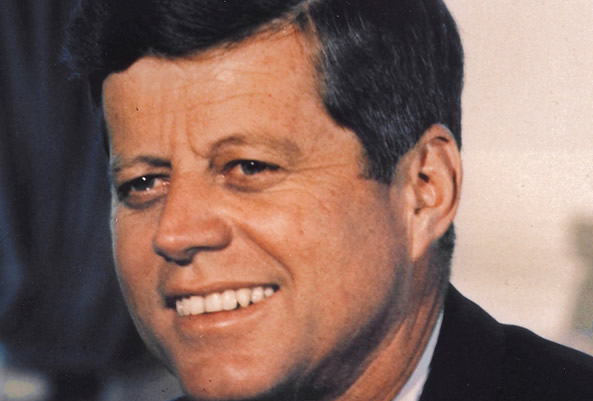
John F. Kennedy |
||
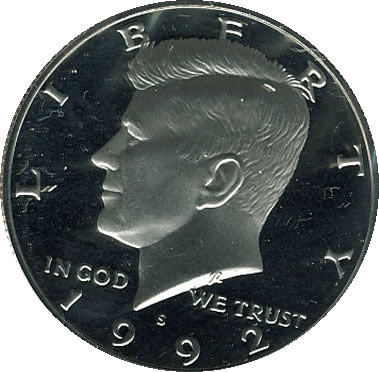
Early LifeJohn Fitzgerald Kennedy was born in Brookline, Massachusetts, on May 29, 1917. He was one of nine children. His siblings were Joe, Rosemary, Kathleen, Eunice, Patricia, Robert, Jean, and Teddy. His mother was Rose Fitzgerald Kennedy and his father was Joseph Patrick Kennedy. The Kennedys were a wealthy, well-connected family, and John attended Choate, a prestigious private boarding school for adolescent boys in Connecticut. He was very popular and had many friends. He played tennis, basketball, football, and golf and also enjoyed reading. In 1936, John enrolled at Harvard University in Cambridge, Massachusetts. Military CourageJohn entered the Navy after graduating from Harvard in 1940. On August 2, 1943, John’s PT 109 patrol boat was hit by a Japanese destroyer, killing two of his men. John managed to save himself and several others in the wreckage. He was awarded the Navy & Marine Corps Medal for leadership and courage. Political CareerKennedy’s political career began soon after World War II. In 1946, he was elected to the Massachusetts 11th congressional district. The popular Kennedy served three terms in the House of Representatives and was elected to the US Senate in 1952. Soon after his election, he married twenty-four-year-old Jacqueline Bouvier, a writer for the Washington Times-Herald. They had two children, Caroline and John, Jr. The Youngest PresidentIn 1960, Kennedy decided to run for president and became the Democratic Party candidate. He chose Texas Senator Lyndon B. Johnson as a running mate to gain support in the southern states. In September and October of 1960, Kennedy and Republican nominee Richard M. Nixon engaged in the first-ever televised presidential candidate debates. On November 8, 1960, Kennedy defeated Nixon for the presidency by an estimated two-tenths of one percent of the vote in one of the closest races in American history. In 1961, at 43 years of age, John F. Kennedy was sworn in as the 35th president of the United States. In his inaugural address, he stressed the importance of citizenship and uttered the famous quote “Ask not what your country can do for you; ask what you can do for your country.” Bay of Pigs FiascoAs President of the United States, Kennedy faced many challenges. His presidency got off to a rough start in 1961 with the infamous failure of the Bay of Pigs invasion. In an attempt to overthrow the Communist regime of Cuban leader Fidel Castro, US military forces suffered an embarrassing defeat at the hands of the Russian-trained Cuban military. The event further deteriorated relations between the United States and Cuba and set the stage for future conflict. Cuban Missile CrisisIn 1962, Kennedy faced what came to be known as the Cuban Missile Crisis. Russia was attempting to position nuclear warheads in Cuba only 90 miles off the coast of Florida. President Kennedy ordered a naval blockade of all ships bound for Cuba. It was a tense time as the world teetered on the verge of nuclear war. Fortunately, Russia withdrew the missiles and agreed to sign the Nuclear Test Ban Treaty. Space Race and DesegregationIn addition, President Kennedy created Project Apollo, which paved the way for American space exploration. He also guided the nation through the difficult period of desegregation. In the early 1960s, President Kennedy challenged students to serve their country in the pursuit of peace by assisting developing countries. As a result, the Peace Corps was created. AssassinationOn November 22, 1963, in Dallas, TX, President John F. Kennedy was shot and killed by Lee Harvey Oswald while riding in a motorcade. It was one of the most shocking news events in the history of the United States. Millions of people mourned. Only two days later, on November 24, 1963, Jack Ruby shot Lee Harvey Oswald dead. LegacyJohn F. Kennedy will forever live on in the hearts of Americans. Since his death, he has been honored by numerous cities and organizations. The Kennedy Center for the Performing Arts in Washington, DC, and the Kennedy Space Center were named for him. He has also appeared on numerous postage stamps as well as the US half-dollar.
Discussion Questions
Glossary
Five Interesting Facts
Most Famous Quote“Ask not what your country can do for you; ask what you can do for your country.” ContextThis quote was delivered by John F. Kennedy during his inaugural address on January 20, 1961, when he was sworn in as the 35th president of the United States. Speaking to a nation at the height of the Cold War, Kennedy urged Americans to take an active role in improving their country and the world. His words inspired a spirit of public service, calling citizens to work together for the common good, whether through military service, civic engagement, or volunteer programs like the newly created Peace Corps. Timeline of John F. Kennedy’s Life
Early LifeJohn Fitzgerald Kennedy was born in Brookline, Massachusetts, on May 29, 1917. He was one of nine children in a wealthy and well-connected family. His parents were Rose Fitzgerald Kennedy and Joseph Patrick Kennedy. John attended Choate, a prestigious boarding school, where he was popular, athletic, and enjoyed reading. In 1936, he entered Harvard University. Military ServiceAfter graduating in 1940, Kennedy joined the Navy. In 1943, his patrol boat PT 109 was struck by a Japanese destroyer. Two crew members died, but Kennedy helped save survivors, earning the Navy & Marine Corps Medal for courage. Political CareerKennedy was elected to the U.S. House of Representatives in 1946 and later to the U.S. Senate in 1952. The following year, he married Jacqueline Bouvier, and they had two children, Caroline and John Jr. President of the United StatesIn 1960, Kennedy ran for president with Lyndon B. Johnson as his running mate. He narrowly defeated Richard M. Nixon and became the youngest elected U.S. president at age 43. In his inaugural speech, he delivered his famous quote: “Ask not what your country can do for you; ask what you can do for your country.” Major Events in OfficeKennedy faced challenges such as the failed Bay of Pigs invasion in 1961 and the Cuban Missile Crisis in 1962, which brought the world close to nuclear war. He promoted the space program through Project Apollo, supported civil rights and desegregation, and founded the Peace Corps to encourage Americans to serve abroad. Assassination and LegacyOn November 22, 1963, Kennedy was assassinated in Dallas, Texas, by Lee Harvey Oswald. His death shocked the nation. He is remembered through places like the Kennedy Center and the Kennedy Space Center, as well as on the U.S. half-dollar coin. |