 |
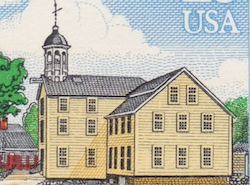
The History of Massachusetts
Massachusetts was founded in 1620 with the arrival of the Pilgrims at Plymouth, followed by the Puritans establishing the Massachusetts Bay Colony in 1630. Over time, it became a center for trade, education, and political activity, playing a key role in sparking the American Revolution. |
|
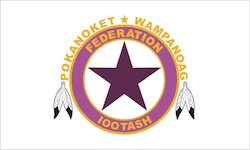 |
Wampanoag Nation
The Wampanoag are a Native American people from what is now southern and eastern Massachusetts, known for their farming, fishing, and seasonal way of life. They played a key role in helping the Pilgrims survive in the early 1600s and were later involved in King Philip's War as they resisted English expansion. |
|
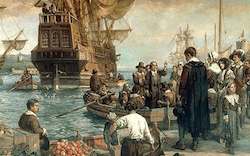 |
Massachusetts Colony
The Massachusetts Colony was founded in 1630 by Puritans seeking religious freedom and the opportunity to build a society based on their religious beliefs. It became one of the most influential New England colonies, known for its role in education, trade, and early democratic practices. |
|
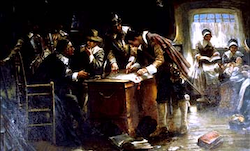 |
Plymouth
The Plymouth Colony was founded in 1620 by English Pilgrims seeking religious freedom, who arrived on the Mayflower and settled in present-day Massachusetts. They established one of the first successful English settlements in North America and signed the Mayflower Compact to govern themselves.
More on Plymouth: The Mayflower | The Mayflower Compact | First Thanksgiving |
|
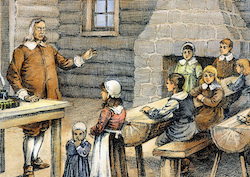 |
Life in Puritan New England
Life in Puritan New England centered on strict religious beliefs, hard work, and community cooperation. Town life revolved around the church, and laws often enforced moral behavior based on Puritan values.
|
|
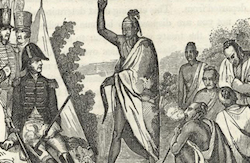 |
King Phillip's War
King Phillip's war was a brutal conflict between Native American tribes in New England and English colonists from 1675 to 1676, led by Wampanoag chief Metacom, known to the english as King Phillip. |
|
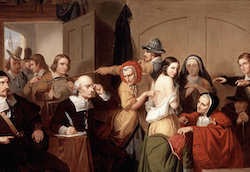 |
Salem Witch Trials
The Salem witch trials took place in 1692 in colonial Massachusetts, when fear and superstition led to accusations of witchcraft. Twenty people were executed and many others imprisoned before the trials were declared unjust. |
|
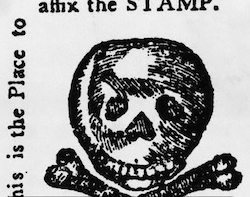 |
Stamp Act
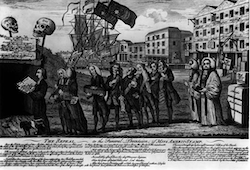
Parliament passed the Stamp Act on March 22, 1765. The Stamp Act required Americans to purchase tax stamps for any printed documents including newspapers, legal documents, marriage licenses and more. |
|
 |
The Townshend Acts
Tension between the British and Americans grew even more intense when Parliament passed the 1767 Townshend Act. The Townshend Act authorized Parliament to issue a new set of taxes on in demand imports such as glass, lead, paint, paper and tea. |
|
 |
The Boston Massacre -
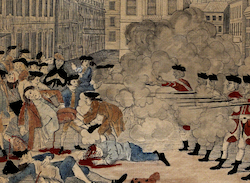
On March 5, 1770, five Americans were killed by British soldiers who fired into an unruly mob. Was it murder? Self-defense?
In Depth: The John Adams Defense | The Bloody Massacre Woodcut |
|
 |
The Boston Tea Party and Intolerable Acts
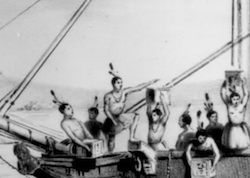
On December 16, 1773, the Sons of Liberty, led by Samuel Adams, planned to show Parliament how they felt about the Tea Act. They boarded the British ship Dartmouth docked in Boston Harbor, dressed up as Indians,and dumped the entire load of tea into the water. This event came to be known as the Boston Tea Party.
In Depth: The East India Company | Mob Etiquette in the Boston Tea Party | Sons of Liberty |
|
 |
Revolutionary War
The American Revolutionary War (1775–1783) was a conflict between the thirteen American colonies and Great Britain, resulting in the colonies gaining independence. It began with growing tensions over British taxation and governance and ended with the Treaty of Paris, which recognized the United States as a sovereign nation. |
|
 |
Battles of Lexington and Concord
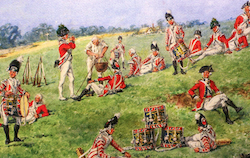
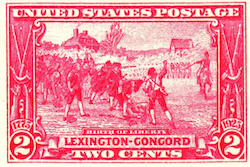
On April 19, 1775, the first shots of Revolutionary War were fired at Lexinton, Massachusetts. No one knows which side fired first, but the event became known as "the shot heard round' the world". 73 British soldiers would be killed as they marched back to Concord.
|
|
 |
Noble Train of Artillery and Defense of Boston
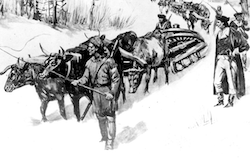
The Noble Train of Artillery was a daring mission led by Colonel Henry Knox in the winter of 1775–1776 to transport cannons from Fort Ticonderoga to Boston. The 300-mile journey through snow and ice helped force the British to evacuate Boston in March 1776. |
|
 |
Battle of Bunker Hill
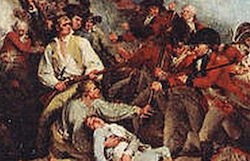
Despite ultimately losing ground, Patriot forces proved their strength at the Battle of Bunker Hill on June 17, 1775, inflicting heavy losses on the British in one of the Revolutionary War’s bloodiest early battles. |
|
 |
The Declaration of Independence
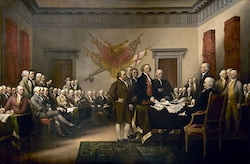
The Declaration of Independence is a historic document written in 1776 that explained why the American colonies chose to break away from British rule. It stated that all people have rights and that governments must have the consent of the governed to be legitimate.
|
|
 |
Shays' Rebellion
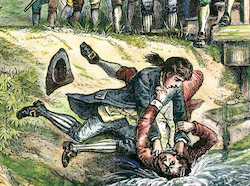
Shays' Rebellion was an armed uprising in 1786–1787 led by Revolutionary War veteran Daniel Shays and other Massachusetts farmers protesting economic injustices and aggressive tax and debt collection. The revolt highlighted the weaknesses of the Articles of Confederation and spurred calls for a stronger national government, eventually leading to the U.S. Constitution. |
|
 |
Civil War
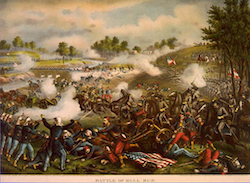
The American Civil War (1861–1865) was fought between the Northern states (Union) and the Southern states that seceded to form the Confederacy, primarily over the issues of slavery and states’ rights. It resulted in the preservation of the Union and the abolition of slavery, but at the cost of over 600,000 lives. |
|