Rutherford B. Hayes |
|
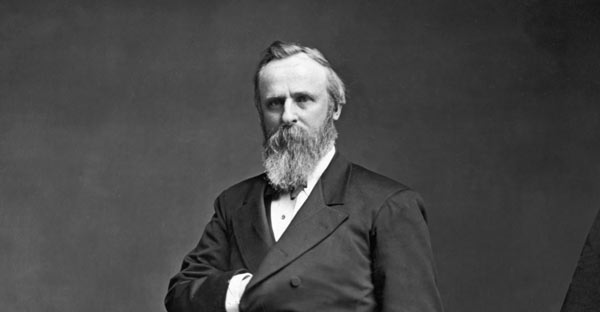
Early Life and EducationRutherford B. Hayes was born in Delaware, Ohio, in 1822. Rutherford’s father, a Scottish storekeeper, died several months before his birth, and his paternal uncle served as his father figure. Rutherford attended Kenyon College in Gambier, Ohio, and graduated in 1842 at the top of his class. He graduated from Harvard Law School in 1845. Rutherford married Lucy Ware Webb in 1856. Together, they had eight children, two of which died before they were three. Civil WarRutherford’s military career began in 1858 when he accepted an appointment as solicitor for the city of Cincinnati. During the US Civil War, Rutherford served as a major in the 23rd Ohio infantry, which fought for Union forces. He would eventually be promoted to major general and would be the only future US president to be wounded in the war. Rutherfraud?Rutherford’s political career began in 1864 when he was nominated to Congress by the governor of Ohio and served from 1868 to 1872. He would serve as governor of Ohio from 1868 to 1872. In 1876, Hayes was nominated for president of the United States, though he was not expected to win. Nevertheless, he proved victorious by one electoral vote, though the Democratic Party alleged the vote was fraudulent and would refer to Hayes as “Rutherfraud B. Hayes.” The election was so close that a special committee known as the Electoral Commission was set up to decide the winner.
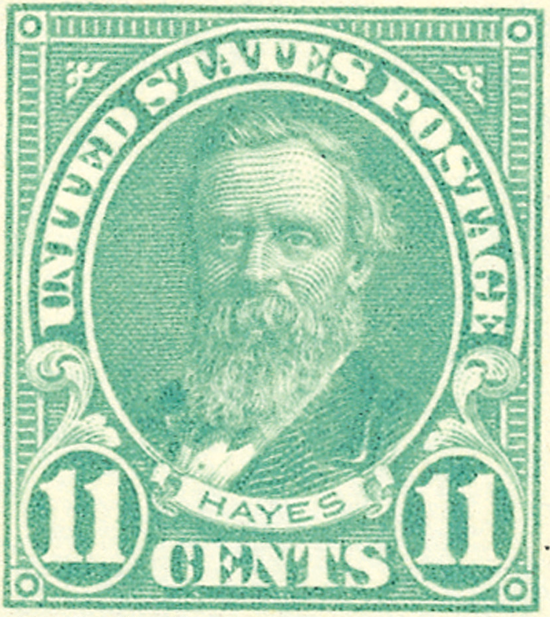
Rutherford B. Hayes Postage Stamp Labor ProblemsOn March 4, 1877, Hayes became the 19th president and first to take the presidential oath in the White House. During his presidency, workers from the Baltimore & Ohio Railroad Company went on strike (refused to work). The strike spread and railroad workers throughout the country refused to work. The labor disputes exploded into riots in several cities, and Rutherford made the controversial decision to send federal troops to control the riots. These troops would eventually fire into some of the crowds of rioters, killing seventy people. Although peace was restored, many were unhappy with Rutherford’s response to the matter. During his presidency, Hayes also signed bills that allowed for the development of lands in the desert southwest and other lands in the west. Rutherford did not run for a second term as president and died of a heart attack on January 17, 1893. Discussion Questions
Glossary
Four Interesting Facts
Early Life and EducationRutherford B. Hayes was born in 1822 in Delaware, Ohio. His father died before he was born, so his uncle became a father figure. He studied at Kenyon College and later at Harvard Law School. He married Lucy Ware Webb in 1856, and they had eight children, though two died young. Civil War ServiceIn 1858, Rutherford became Cincinnati’s solicitor. He joined the Union Army during the Civil War, rising to the rank of major general. He was the only future U.S. president wounded in that war. Political Career and PresidencyHayes began his political career in Congress in 1864 and later became governor of Ohio. In 1876, he became president after a very close and disputed election, earning him the nickname “Rutherfraud.” A special Electoral Commission had to decide the winner. Labor Strikes and LegacyHayes took office in 1877 and faced major labor strikes. He controversially sent federal troops to stop the riots, which led to the deaths of 70 people. He also supported development in the western U.S. Hayes chose not to run again and died in 1893. |