 |
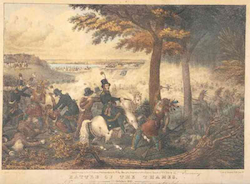
The History of Ohio
Ohio became the 17th state in 1803, after being part of the Northwest Territory. It played a key role in westward expansion and was an important center for abolitionist activity before the Civil War. |
|
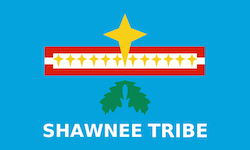 |
Shawnee Nation
The Shawnee Nation is a Native American tribe originally located in the Ohio Valley region, known for their skilled diplomacy and resistance against colonial expansion. Today, Shawnee communities primarily reside in Oklahoma, preserving their language, culture, and traditions. |
|
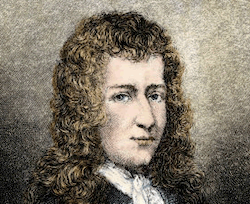 |
The Explorations of Robert Sieur de la Salle
Robert Sieur de La Salle was a French explorer who claimed the entire Mississippi River Basin for France in 1682, naming it Louisiana. His ambitious expeditions expanded French influence in North America, though his final colonization attempt ended in disaster and his own death. |
|
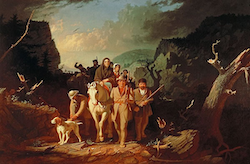 |
The Northwest Territory
The Northwest Territory was a vast area of land in the early United States, stretching from the Great Lakes to the Ohio River and including parts of modern-day Ohio, Indiana, Indiana, Michigan, Wisconsin, and Minnesota. It was gained after the British ceded it following the French and Indian War and eventually became the foundation for several new states.
|
|
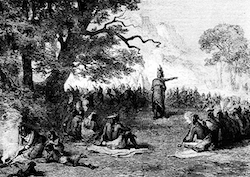 |
Pontiac's Rebellion
Pontiac's Rebellion was a war waged by Indians of the Great Lakes region against British rule after the French and Indian War. The Indians, who had formed alliances with the defeated French, were dissatisfied with treatment from British officials. |
|
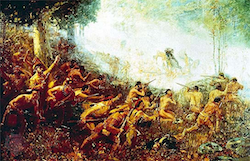 |
French and Indian War
The French and Indian War, also known as the Seven Years War, began in the Spring in 1754. The dispute arose over the presence of British and French settlers in the Ohio River Valley (in and around present day Pittsburgh, Pennsylvania), but resulted in battles that were fought far from there. |
|
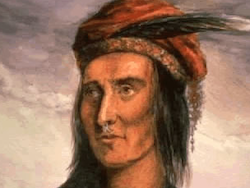 |
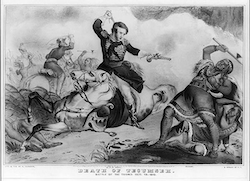
Tecumseh's War
Tecumseh's War was a conflict in the early 1800s between a Native American confederation, led by Shawnee chief Tecumseh, and the United States, as Native tribes tried to resist American expansion into their lands. The war ended after Tecumseh’s death in 1813 during the War of 1812, weakening Native resistance in the Midwest. |
|
 |
War of 1812
The War of 1812 was a conflict between the United States and Great Britain, sparked by issues like trade restrictions and the impressment of American sailors. It ended in 1815 with the Treaty of Ghent, restoring prewar boundaries but boosting American national pride. |
|
 |
Siege at Fort Meigs - May 1-9, 1813
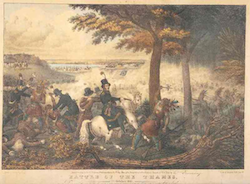
The Siege of Fort Meigs took place in 1813, when British and Native forces led by General Henry Proctor and Tecumseh attacked the American fort in northwest Ohio. Despite eight days of bombardment and heavy losses, the Americans held the fort, and the British were forced to retreat. |
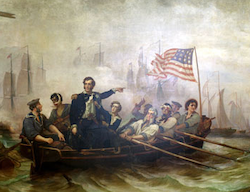 |
Battle of Lake Erie - September 10, 1813
The Battle of Lake Erie was fought on September 10, 1813, and resulted in a major American naval victory during the War of 1812. U.S. Commander Oliver Hazard Perry defeated the British fleet, securing control of the lake and boosting American morale. |
|
 |
Manifest Destiny
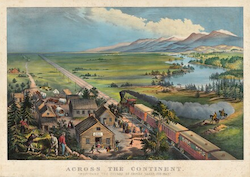
Manifest Destiny was the 19th-century belief that the United States was destined by God to expand its territory across North America. It was used to justify westward expansion, the displacement of Native Americans, and wars such as the Mexican-American War. |
|