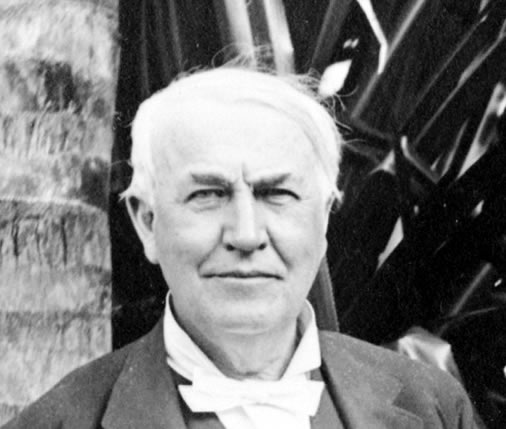
Thomas Edison |
||
Thomas Edison was born February 11, 1847, in Milan, Ohio. He was nicknamed “Al” at an early age. At age 11, Edison moved to Michigan where he spent the remainder of his childhood. Tramp TelegrapherThomas Edison struggled in school but learned to love reading and conducting experiments from his mother who taught him at home. At age 15, Edison became a “tramp telegrapher,” sending and receiving messages via Morse code, an electronically conveyed alphabet using different clicks for each letter. Eventually, he worked for the Union Army as a telegrapher. Edison often entertained himself by taking things apart to see how they worked. Soon, he decided to become an inventor. Improving the TelegraphIn 1870, Edison moved to New York City and improved the stock ticker. He soon formed his own company that manufactured the new stock tickers. He also began working on the telegraph and invented a version that could send four messages at once. Meanwhile, Edison married Mary Stillwell, had three children, and moved his family to Menlo Park, New Jersey, where he started his famous laboratory. The Phonograph and Light BulbIn 1877, Edison, with help from “muckers,” individuals from around the world looking to make fortunes in America, invented the phonograph. The phonograph was a machine that recorded and played back sounds. He perfected the phonograph by recording “Mary Had a Little Lamb” on a piece of tin foil! In 1878, Edison invented the light bulb as well as the power grid system, which could generate electricity and deliver it to homes through a network of wires. He subsequently started the Edison Electric Light Company in October of 1878.
Edison LaboratoryIn 1884, after he attained great fame and fortune, Mary Stillwell died. Edison remarried 20-year-old Mina Miller in 1886. He had three more children and moved to West Orange, New Jersey. At West Orange, Edison built one of the largest laboratories in the world. He worked extremely hard and registered 1,093 patents. Edison continued to invent or improve products and make significant contributions to X-ray technology, storage batteries, and motion pictures (movies). He also invented the world’s first talking doll. His inventions changed the world forever. They still influence the way we live today. Edison worked until his death on October 18, 1931. Discussion Questions
Glossary
Interesting Facts
Early LifeThomas Edison was born on February 11, 1847, in Milan, Ohio. As a young boy, he was called “Al.” When he was 11, his family moved to Michigan, where he grew up. Edison did not do well in school, but his mother taught him at home and encouraged his interest in books and science. Becoming a TelegrapherAt age 15, Edison became a telegrapher and traveled to send and receive Morse code messages. He worked for the Union Army and enjoyed taking machines apart to see how they worked. This curiosity helped him decide to become an inventor. First Inventions and BusinessIn 1870, Edison moved to New York City. He improved the stock ticker and started his own company to produce it. He also invented a new telegraph that could send four messages at once. Edison married Mary Stillwell and had three children. He built a laboratory in Menlo Park, New Jersey, where he worked on many new ideas. The Phonograph and the Light BulbWith the help of his assistants, Edison invented the phonograph in 1877. It was the first machine that could record and play back sound. He recorded the nursery rhyme “Mary Had a Little Lamb” on tin foil. In 1878, Edison created the electric light bulb and built a power system to deliver electricity to homes. That same year, he started the Edison Electric Light Company. Later Years and LegacyAfter his wife Mary died in 1884, Edison married Mina Miller in 1886. They had three more children and moved to West Orange, New Jersey. There, Edison built a giant laboratory where he continued inventing. He received 1,093 patents during his life and made major contributions to batteries, X-ray technology, motion pictures, and even created the first talking doll. Edison worked until he died on October 18, 1931. His inventions changed the world and are still important today. |
||
| Thomas Edison Activities | ||
|