William McKinley |
||||
|
||||
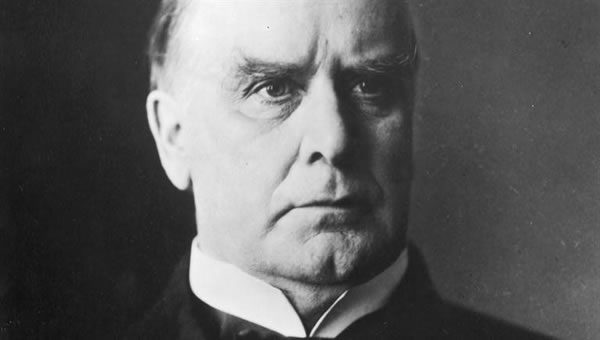
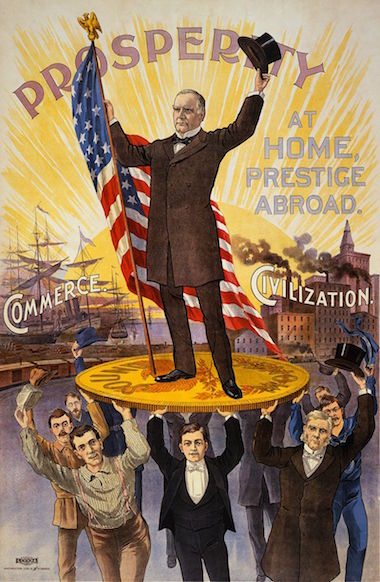
Early LifeWilliam McKinley was born on January 29, 1843, in Niles, Ohio. He was the seventh of nine children. He attended Allegheny College in Meadville, Pennsylvania, for one term before enlisting in the Union Army during the Civil War. After the war, McKinley was admitted to the New York Bar after graduating from Albany Law School. Supporting the Working ManIn 1871, he married Ida Saxton. McKinley became active in the Republican Party and campaigned for Rutherford B. Hayes' gubernatorial run in Ohio. He also gained a reputation as an excellent and compassionate lawyer after he refused payment from a group of 33 miners he successfully defended (except for one) for rioting against their employer. McKinley was elected to the Ohio House of Representatives in 1877 and served until 1882. He was elected a second time in 1885 and served until 1891. In 1891, he was elected governor of Ohio, where he passed legislation advocating worker safety and worker Unions. McKinley further cemented his reputation as an advocate of the working man in 1895 when he paid for provisions of food for a group of impoverished miners and organized a charity drive benefiting 10,000 people living in poverty in Ohio. 25th PresidentIn 1896, McKinley received the Republican nomination for President of the United States. McKinley campaigned on a platform that emphasized industry, banking, and opportunity for all and defeated his Democratic opponent William Jennings Bryan, becoming the nation's 25th President. The Spanish-American WarAs President, McKinley was true to his word. Business and agriculture thrived during his presidency. Nevertheless, his presidency was dominated by foreign relations, especially with Spain. The United States had interests in several Spanish colonies including Cuba and the Philippines. These colonies were thought to be in virtual rebellion thanks to sensationalized stories in the newspapers and publications of William Randolph Hearst. Such stories stirred the emotions of its readers and prompted many to urge McKinley to declare war on Spain. In 1898, the warship U.S.S. Maine was mysteriously sunk in Havana Harbor (Cuba), killing 260 men. Congress soon declared war and U.S. forces easily defeated the Spanish in Cuba and the Philippines in what came to be known as the Spanish American War. In the treaty that followed, the United States gained ownership of the Philippines, Guam, and Puerto Rico and temporary control over Cuba. Soon after, the United States annexed the Hawaiian Islands in the Pacific Ocean. The acquisition of the Philippines would lead to the Philippine-American War. In 1900, McKinley was re-elected as President, defeating William Jennings Bryan for a second time. That year, he signed the Gold Standard Act which made gold the only standard for redeeming paper money.
AssassinationOn September 5, 1901, however, as he was attending the Pan-American Exposition in Buffalo, New York, he was shot by anarchist Leon Frank Czolgosz. Despite the fact that doctors thought McKinley would initially survive, his wounds became gangrenous and he died on September 14th. Theodore Roosevelt would be sworn in as the nation's 26th president. His killer would be executed by electric chair. Today, there are numerous monuments to McKinley throughout the country. Schools, counties, streets, and statues are dedicated to him in many different states. He is interred at the McKinley Memorial Mausoleum in Canton, Ohio, near the McKinley Presidential Library and Museum.
Discussion Questions
Glossary
Four Interesting Facts
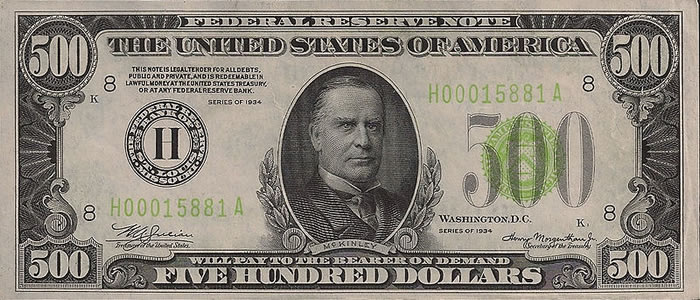
Early Life and EducationWilliam McKinley was born in 1843 in Niles, Ohio, one of nine children. He attended college briefly before joining the Union Army during the Civil War. Afterward, he studied law and became a lawyer in New York. Political Rise and Support for WorkersMcKinley married Ida Saxton in 1871 and became active in Republican politics. He gained attention for defending miners and helping the poor. He served in the Ohio House of Representatives and was later elected governor, where he supported worker safety and unions. Presidency and War with SpainIn 1896, McKinley was elected the 25th President. His first term was successful for business and farming. But foreign affairs, especially with Spain, became the main focus. The sinking of the U.S.S. Maine led to the Spanish-American War. The U.S. won quickly, gaining control of several territories including the Philippines, Guam, and Puerto Rico. He was re-elected in 1900 and signed the Gold Standard Act. Assassination and LegacyIn 1901, McKinley was shot by an anarchist at a public event. He died days later from infection. Theodore Roosevelt became president. McKinley is honored with many memorials and was once featured on the U.S. $500 bill. |