James Monroe |
||||
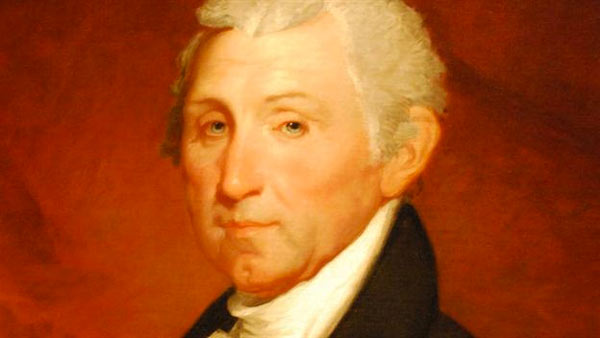
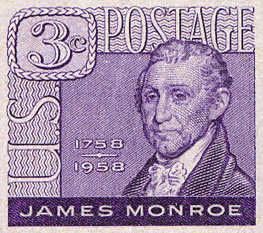
Early LifeJames Monroe was born on April 28, 1758, in Westmoreland County, Virginia . He attended the College of William and Mary before joining the Continental Army, where he was wounded at the Battle of Trenton in 1776. It is Monroe who is depicted holding the flag in the famous painting of Washington crossing the Delaware . The image is also depicted on the back of the New Jersey state quarter. After the war, he practiced law in Fredericksburg and married Elizabeth Kortright in 1786. Numerous Important Political PositionsMonroe's political career moved quickly in the new nation. He participated in the Continental Congress from 1783 to 1786 and was elected as a Virginia Senator in 1790. From 1794-1796, he served as Minister to France during the French Revolution. From 1799-1802, he served as Virginia's Governor and he served as Minister of the Court of St. James (Ambassador to England) from 1803 to 1807 in Thomas Jefferson's administration. During the Madison administration, Monroe served at various times as Secretary of State and Secretary of War.
President During the Era of Good FeelingIn 1816, James Monroe was elected America's fifth president. His presidency lasted two terms from 1817-1825 and was referred to as The Era of Good Feeling because of the relative lack of political bitterness between the Federalists and the Democratic-Republican Party. The "good feeling," however, was short-lived as a painful economic depression swept through the country as a result of the Panic of 1819. That same year, Congress became locked in a bitter debate over the admission of Missouri as a slave state that finally ended with the Missouri Compromise in 1820. As part of the compromise, Missouri was admitted as a slave state and Maine as a free state.
The Monroe DoctrineMonroe is probably best known for the Monroe Doctrine, a document largely written by John Quincy Adams. The document outlined America's foreign policy stance and proclaimed neutrality in European affairs. It also condemned European colonization and declared that such colonization in North and South America was a direct threat to the United States. The Third of the First Five Presidents to die on July 4thAfter his second term in office ended in 1825, Monroe lived at Monroe Hill on the campus of the University of Virginia. The current campus served as Monroe’s farm from 1788 to 1817, when he sold it to the university. Racked by debt, he lived a humble existence before moving to New York City after the death of his wife in 1830. He died on July 4, 1831, of tuberculosis and heart failure, becoming the third president to die on July 4. He was originally buried in New York City but now lies in Richmond, Virginia. In 1824, the capital city of the African nation of Liberia was renamed Monrovia in his honor. It is the only foreign capital named after a US president. Discussion Questions
Glossary
Five Interesting Facts
Timeline of 10 Key Events
Early LifeJames Monroe was born on April 28, 1758, in Virginia. He studied at the College of William and Mary and fought in the Continental Army, where he was wounded at Trenton. After the war, Monroe became a lawyer and married Elizabeth Kortright in 1786. Political CareerMonroe served in the Continental Congress, was a U.S. Senator, and held diplomatic posts in France and England. He also served as Governor of Virginia and later became Secretary of State and Secretary of War during the Madison presidency. Presidency and the Era of Good FeelingMonroe was elected as the fifth president in 1816. His time in office was called the Era of Good Feeling, though it saw troubles like the Panic of 1819 and the Missouri Compromise of 1820 over slavery. The Monroe DoctrineHis most famous policy, the Monroe Doctrine, warned Europe against colonizing the Americas and established U.S. influence in the Western Hemisphere. Later Life and DeathAfter his presidency, Monroe lived modestly and later moved to New York City. He died on July 4, 1831, and is honored by the city of Monrovia in Liberia, named after him. |