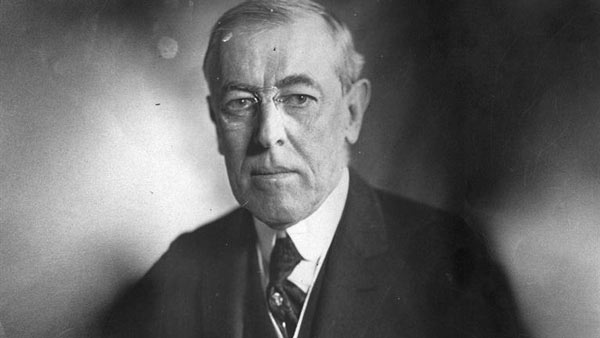
Woodrow Wilson |
|||||||||||||
Early Life and EducationWoodrow Wilson was born on December 28, 1856, in Staunton, Virginia, but lived in Georgia and South Carolina in his childhood as well. He was the third of four children. Wilson was well education and graduated from Princeton University in 1879 where he excelled at debate. Following his graduation, Wilson attempted to study law, but found his studies laborious. Instead, Wilson was accepted to a Ph. D program in political science from Johns Hopkins University in Baltimore. He graduated three years later. A year earlier, Wilson married Ellen Axson. Professor and AuthorFollowing his Ph. D, Wilson served as a professor at Cornell University, Bryn Mawr College Wesleyan University and eventually Princeton. During this time Ellen gave birth to two daughters, Margaret and Jessie. Wilson soon became an accomplished political science and history author. His texts on the function of government and 19th century history were used in many American universities. By 1902, Wilson had been elevated to president of Princeton University, a position which he held for eight years. Out of Nowhere!In 1910, Wilson took the political world by storm when he was elected as governor of New Jersey and then won the Democratic nomination for president in 1912. Wilson, who advertised himself as a "progressive," easily won the election over Republicans William Howard Taft and Theodore Roosevelt. Wilson would become the nation's first southern-born president since Zachary Taylor in 1848. In 1914, however, Wilson's wife died of kidney disease. Wilson would marry Edith Bolling the following year. As President..
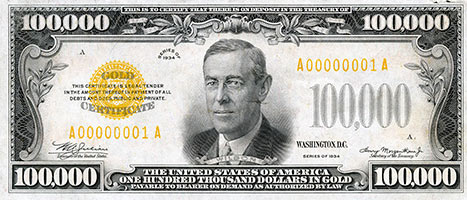
World War IWilson's second term was dominated by World War I. Upon the outbreak of the war, Wilson maintained a policy of neutrality, even after German U-boats sunk several ships that carried American passengers, including the British liner RMS Lusitania. When Germany refused to curtail their submarine warfare, and attempted to broker a partnership with Mexico, Wilson declared war on Germany citing, "the world must be must be made safe for democracy." Over 2.8 million men and boys were drafted for military service. Wilson successfully guided the nation through the war. Fourteen PointsIn 1918, Wilson issued his famous "Fourteen Points," a statement and speech outlining his vision of a free world, successful foreign policy, democracy, trade equality, free navigation, and solutions to territorial disputes in Europe. His speech ended with the promotion of the League of Nations, an organization of nations formed to promote world peace, disarmament, and diplomacy. In 1919, Wilson was issued the Nobel Peace Prize for his work in promoting the League of Nations. Nineteenth AmendmentIn 1918, Wilson promoted the passage of the 19th Amendment, which gave women the right to vote. In October of 1919, however, Wilson suffered a serious stroke, leaving him partially paralyzed. Following his second term in office, Wilson and his wife moved to a townhouse in Washington, D.C. On February 3, 1924, Woodrow Wilson died from another stroke. His wife would live in the townhouse another 37 years before dying at the age of 89. On the day of her death, the Woodrow Wilson Bridge, connecting Maryland and Virginia, was dedicated. In 1934, the $100,000 bill, the largest U.S. Currency note ever printed, honored Woodrow Wilson.
Most Famous Quote"The world must be made safe for democracy." – Woodrow Wilson Timeline of Woodrow Wilson's Life
Five Interesting Facts
Glossary
Discussion Questions
Early Life and EducationWoodrow Wilson was born on December 28, 1856, in Virginia and grew up in Georgia and South Carolina. He graduated from Princeton in 1879 and later earned a Ph.D. in political science from Johns Hopkins. In 1885, he married Ellen Axson. Academic CareerWilson taught at several universities and became president of Princeton in 1902. He wrote influential books on government and history. Political RiseIn 1910, Wilson became governor of New Jersey and, two years later, president of the United States. He won as a progressive candidate and was the first southern-born president since 1848. His first wife died in 1914; he remarried in 1915. Presidency and World War IWilson passed key laws like the Federal Reserve Act and the Clayton Antitrust Act. He led the U.S. through World War I, declaring war in 1917 after German aggression. His famous statement was, "The world must be made safe for democracy." Fourteen Points and Later LifeIn 1918, Wilson proposed the Fourteen Points, promoting peace and creating the League of Nations. He received the Nobel Peace Prize in 1919 but suffered a stroke later that year. Wilson supported the 19th Amendment for women's voting rights. He died in 1924 in Washington, D.C. |