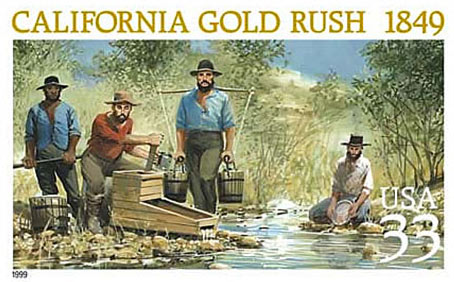
California Gold Rush |
||
Don't Tell Anyone!On January 24, 1848, James W. Marshall found gold at Sutter's Mill in Coloma, California, near present-day Sacramento. Marshall, who was working in a lumber mill for John Sutter, happened upon a shiny metal. Marshall brought an example of the metal to Sutter. Tests on the metal revealed it was indeed gold! Sutter, however, wanted to keep the news quiet as he was worried word of gold would create a frenzy that would threaten his dream of an agricultural empire in California. Here Come the 49ers! Thanks, President PolkSutter, however, could not contain news of the discovery. In December of 1849, President James K. Polk confirmed to the world that gold was discovered in California in an address to Congress. The news quickly spread, and soon, settlers, known as 49ers, arrived by the tens of thousands via wagon and ship, to search for gold in California. Sutter's land would quickly be overwhelmed by gold seekers who ruined his land, stole his crops, killed his livestock, and destroyed his plans. California became a lawless place as racism, violence, disease, and mining accidents collectively added to the tension. The Rush to CaliforniaOf the 90,000 estimated settlers who arrived in California in 1849, 60,000 were thought to be American, and the remainder came from foreign countries. Many billions of dollars worth of gold were reportedly found, making many families instantly wealthy. Furthermore, at the genesis of the gold rush, there were no fees, rules, or taxes that governed the collection of gold. It was free for the taking on a first come first serve basis. As more and more settlers poured into the state, California developed a constitution and government. As part of the Compromise of 1850, California joined America as a free state and soon ranching and agriculture expanded throughout the state to meet the needs of the its burgeoning population. The city of San Francisco, with little more than a few hundred settlers in 1848, boomed to a population of over 25,000 by 1850. By 1855, at least 300,000 settlers had relocated to California. By this time, however, most of the gold that could be easily retrieved by individuals was gone and larger mining outfits took over with the technology required to further extract gold.
Don't Tell Anyone!On January 24, 1848, James W. Marshall found gold at Sutter's Mill near Sacramento, California. He was working for John Sutter, who hoped to keep the discovery a secret so it wouldn’t disrupt his farming plans. Here Come the 49ers! Thanks, President PolkSutter couldn't keep the gold discovery a secret. In December 1849, President James K. Polk confirmed the discovery in a speech to Congress. Soon, thousands of people—called 49ers—rushed to California to find gold. They overran Sutter’s land, ruined his crops, stole from him, and destroyed his dreams. California quickly became a chaotic place full of violence, racism, and disease. The Rush to CaliforniaAbout 90,000 people arrived in California in 1849, most of them Americans, with many others from around the world. Billions of dollars’ worth of gold were found, and some people became very rich. At first, there were no laws or taxes, so anyone could take gold if they found it. As more people arrived, California created a government and became a free state in 1850 as part of the Compromise of 1850. San Francisco grew from a small village to over 25,000 people by 1850. By 1855, around 300,000 people had moved to California. By then, most of the easy-to-find gold was gone, and large mining companies took over using machines and new technology. |
||