Expansion and Growth |
|
This huge section of LearnaboutAmerica.com includes articles, activities, interactives, and printables on all of the major events in the era of Westward Expansion and growth. |
|
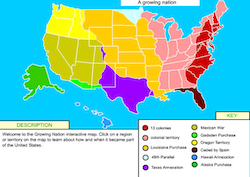 |
American Growth and Expansion Interactive Map This resource allows students to learn about the wars, annexations, and acquisitions of this time period by clicking points on an interactive map. It also contains printable and interactive scavenger hunts. |
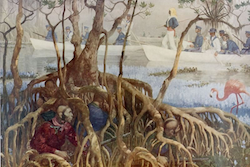 |
King Phillip's War, the Seminole Wars, the Black Hawk War, Dakota Wars, and the Comanche Wars, are just a few of the campaigns waged on the native peoples by setllers or the United States government between the early 1600s and late 1800s. Click above to learn about many of these wars. |
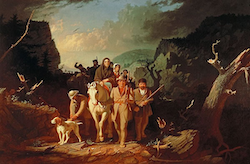 |
The Northwest Territory was a vast area of land in the early United States, stretching from the Great Lakes to the Ohio River and including parts of modern-day Ohio, Indiana, Illinois, Michigan, Wisconsin, and Minnesota. It was gained after the British ceded it following the French and Indian War and eventually became the foundation for several new states. |
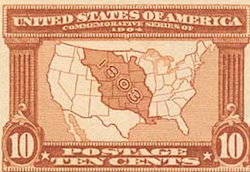 |
The Louisiana Purchase was a land deal in 1803 where the United States bought over 800,000 square miles of territory from France for $15 million, doubling the size of the nation. It gave the U.S. control of the Mississippi River and opened the way for westward expansion. |
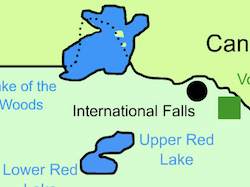 |
The 49th Parallel - Defining American/Canadian Boundaries The decision to use the 49th parallel as the border between U.S. and British territory was made in the Anglo-American Convention of 1818 to resolve boundary disputes. It established a clear line from the Great Lakes to the Rocky Mountains, with land north belonging to Britain and land south to the United States. |
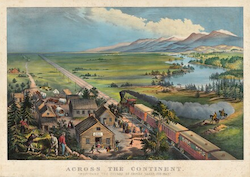 |
Manifest Destiny was the 19th-century belief that the United States was destined by God to expand its territory across North America. It was used to justify westward expansion, the displacement of Native Americans, and wars such as the Mexican-American War. |
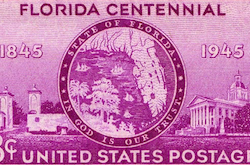 |
The Adams-Onis Treaty and Acquisition of Florida The Adams-Onis Treaty of 1821 was an agreement between the United States and Spain in which the U.S. acquired Florida and settled boundary disputes from the Louisiana Purchase. In return, the U.S. paid up to $5 million in American claims against Spain and gave up claims to parts of Texas and the Southwest. |
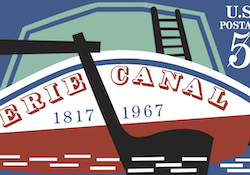 |
The Erie Canal, completed in 1825, connected the Great Lakes to the Atlantic Ocean by linking Lake Erie to the Hudson River and New York City. It drastically reduced shipping costs and helped boost trade, population growth, and the economy in New York and the surrounding Great Lakes region. |
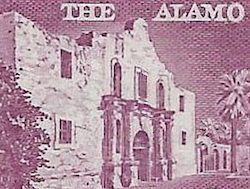 |
Texas Independence and the Battle of the Alamo Texas gained its independence from Mexico in 1836 after a series of conflicts, including the Battle of San Jacinto, where Texan forces led by Sam Houston defeated the Mexican army and captured General Santa Anna. Following this victory, Texas became an independent republic, which was later annexed by the United States in 1845, sparking tensions that led to the Mexican-American War. |
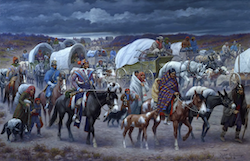 |
The Trail of Tears refers to the forced removal of the Cherokee people in 1838, during which nearly 4,000 died on a brutal 1,000-mile march to present-day Oklahoma. |
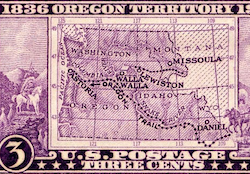 |
The Oregon Territory was a region in the Pacific Northwest that included present-day Oregon, Washington, Idaho, and parts of Montana and Wyoming. It was jointly claimed by the United States and Great Britain until the 1846 Treaty of Oregon established the U.S. border at the 49th parallel. |
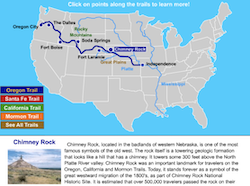 |
The Oregon, California, Santa Fe, and Mormon Trails were thought of as pathways to better lives for millions of Americans. Take interactive tours of each of these historic trails to learn all about what life was like traveling along them.
|
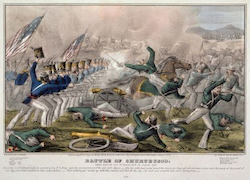 |
Mexican-American War and the Acquisition of the West The Mexican-American War (1846–1848) was a conflict between the United States and Mexico following the U.S. annexation of Texas and disputes over the southern border. It ended with the Treaty of Guadalupe Hidalgo, through which the U.S. gained a large portion of the Southwest and established the Rio Grande as the border with Mexico. |
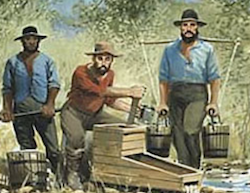 |
The California Gold Rush began in 1848 when gold was discovered at Sutter’s Mill, drawing hundreds of thousands of people to California in search of fortune. This rapid migration transformed California’s economy and population, eventually leading to its statehood in 1850. |
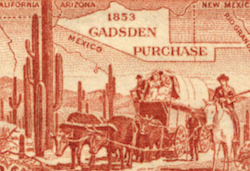 |
The Gadsden Purchase was an agreement in 1853 in which the United States acquired land from Mexico, roughly 29,670 square miles in present-day southern Arizona and New Mexico, for $10 million. The purchase was intended to facilitate the construction of a southern transcontinental railroad and solidify U.S. control over the region following the Mexican-American War. |
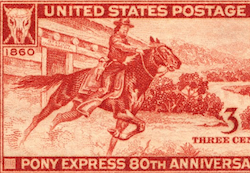 |
The Pony Express was a fast mail delivery service that operated from April 1860 to October 1861, using a relay of horseback riders to carry mail between Missouri and California in just 10 days. Though short-lived, it played a key role in improving communication across the expanding American frontier. |
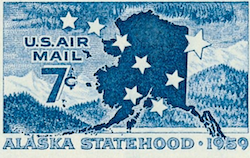 |
The Alaska Purchase was the 1867 agreement in which the United States bought Alaska from Russia for $7.2 million. Though initially mocked as "Seward's Folly," it proved valuable due to Alaska's rich natural resources and strategic location. |
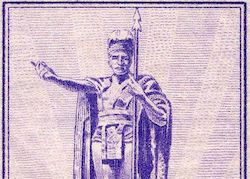 |
The annexation of Hawaii occurred in 1898 after American-backed planters overthrew the Hawaiian monarchy and pushed for U.S. control to protect their economic interests. Although its legality remains debated, Hawaii’s strategic location in the Pacific made it a valuable addition to the United States. |