Indian Wars |
|
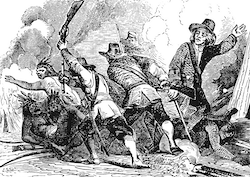 |
The Pequot War was a conflict in 1636-1638 between the Pequot tribe and English colonists in New England, along with their native allies. The war ended with the near destruction of the Pequot people, including the massacre of hundreds in the Mystic River attack. |
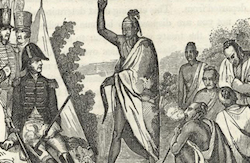 |
King Phillip's war was a brutal conflict between Native American tribes in New England and English colonists from 1675 to 1676, led by Wampanoag chief Metacom, known to the english as King Phillip. |
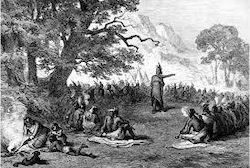 |
Pontiac's Rebellion was a Native American uprising in 1763, led by Ottawa chief Pontiac, in response to British control and settlement in the Great Lakes region after the French and Indian War. Native tribes united to attack British forts and settlements, aiming to resist colonial expansion and protect their lands. |
|
The Chickamauga Wars were a series of battles, ambushes, and massacres staged between Cherokee forces under Dragging Canoe and the many militias comprised of Scotch-Irish settlers in Kentucky, the Carolinas, Tennessee, and Georgia during and after the Revolutionary War. |
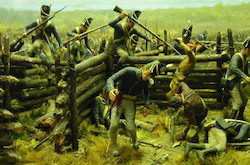 |
The Creek War (1813–1814) was a conflict between the United States and a faction of the Creek Nation known as the Red Sticks, who opposed American expansion. It ended with a U.S. victory led by Andrew Jackson at the Battle of Horseshoe Bend, forcing the Creeks to give up millions of acres of land. |
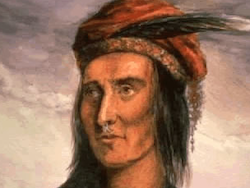 |
Tecumseh's War was a conflict in the early 1800s between a Native American confederation, led by Shawnee chief Tecumseh, and the United States, as Native tribes tried to resist American expansion into their lands. The war ended after Tecumseh’s death in 1813 during the War of 1812, weakening Native resistance in the Midwest. |
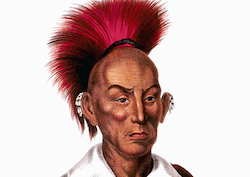 |
The Black Hawk War was a conflict between the U.S. military and the Sauk and Fox tribes in 1832, led by the Sauk leader Black Hawk, as they resisted being displaced from their lands in Illinois. After a series of battles, Black Hawk and his followers were defeated, and the U.S. government forced them to surrender and give up their land. |
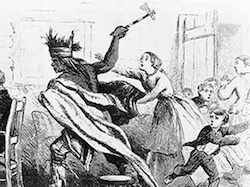 |
Cayuse War and Whitman Massacre The Cayuse War was a conflict between the Cayuse tribe and U.S. settlers and that began after the Whitman Massacre in 1847, when the Cayuse killed missionaries Marcus and Narcissa Whitman. In response, the U.S. military and local militias attacked the tribe, executed five Cayuse warriors, and took most of the tribe’s land. |
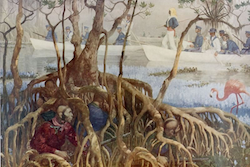 |
The Seminole Wars were a series of conflicts between the U.S. military and the Seminole tribe in Florida, beginning in 1817 and lasting until 1858. These wars were primarily driven by the U.S. government's efforts to remove the Seminoles from their land, with the Seminoles fiercely resisting, especially under leaders like Osceola, and ultimately being forced onto reservations in Oklahoma. |
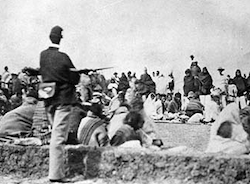 |
The Navajo Wars were a series of conflicts in the 1800s between the U.S. military and the Navajo people, sparked by settler expansion and the building of forts on Navajo land. After years of fighting, the Navajo were forced to surrender and endure the Long Walk—a 300-mile forced march to a New Mexico reservation during which hundreds died from starvation and exposure. |
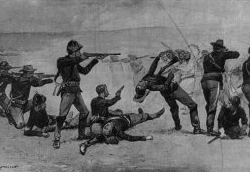 |
The Dakota Wars were a series of violent conflicts between the Dakota (Sioux) people and American settlers in Minnesota. Sparked by broken treaty promises and widespread starvation, the war led to hundreds of deaths and ended with mass executions and the forced removal of the Dakota from their homeland. |
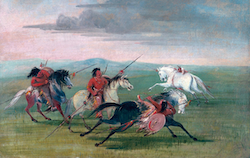 |
The Comanche Wars were a series of conflicts between the Comanche and U.S. forces in the southern plains, sparked by settler expansion and broken government promises. Despite fierce resistance, including major battles like Adobe Walls, the Comanche were eventually forced onto a small reservation, losing most of their ancestral lands. |