The Oregon Territory |
|
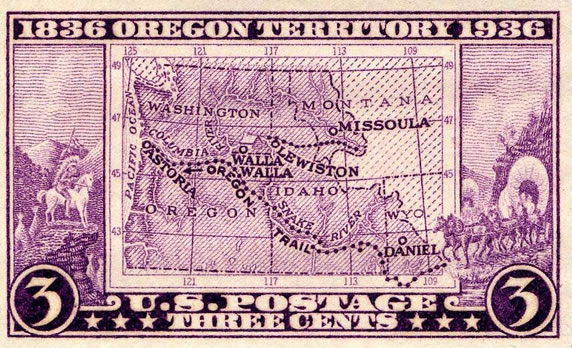
The Oregon Territory, including modern-day Washington, Oregon, Idaho, and parts of Montana and Wyoming, was a territory claimed by both the United States and Great Britain prior to 1848. It was initially designated as an area of "joint occupation" after the 1818 Anglo-American Convention. Joint control of the area caused numerous territorial conflicts, threatened each nation's commercial interests, and nearly caused a war. The 1846 Treaty of Oregon, between the two nations, put a permanent end to the settlement question. Negotiated by future president James Buchanan, the treaty set the boundary between American lands and British lands at the 49th parallel, extending west to the Pacific Ocean. As an exception to the treaty, Great Britain retained Victoria Island. The Oregon Territory—now parts of Washington, Oregon, Idaho, Montana, and Wyoming—was once claimed by both the U.S. and Great Britain. After 1818, they agreed to share control, but this caused conflicts and risked war. In 1846, the Treaty of Oregon ended the dispute. It set the border at the 49th parallel, with Britain keeping Victoria Island. |