The Treaty of New Echota and Trail of Tears |
||
|
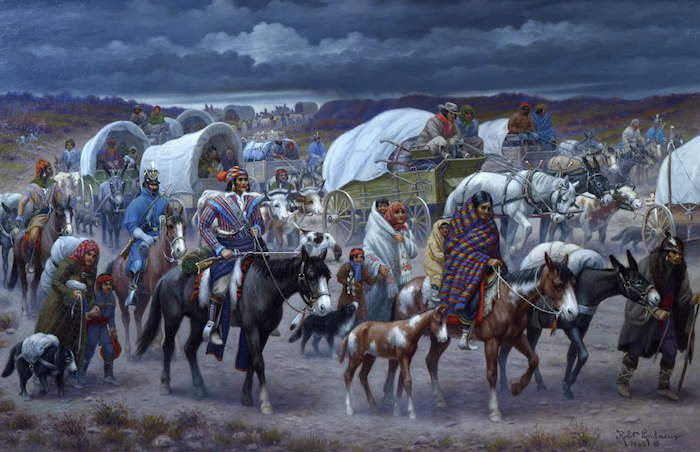
America’s population was booming and spreading west in the early 1800’s. Westward expansion came mostly at the expense of the Indians who were often forced to move from their native lands. Georgia Land GrabIn the state of Georgia, the population increased 600 percent in the matter of 40 years. As a result, many of its native tribes were pushed out. The Cherokee Indians, of western Georgia had managed to keep their land until gold was discovered in their territory in 1828. In 1830, however, president Andrew Jackson authorized the Indian Removal Act. The Cherokees fought the law, and it was overturned by chief justice John Marshall two years later. The "Treaty"Just three years later, however, in 1835, the Treaty of New Echota was signed. The “Treaty” was not authorized by the Cherokee Nation, but rather, a small group of Cherokee radicals led by John Ridge. Under the “Treaty”, the Cherokee were to leave Georgia and the government would compensate them at a price determined to be about 5 percent of the value of the land. The majority of the Cherokee Nation would never had agreed to the “Treaty”, but the U.S. government ratified it anyway. John Ridge was thus seen as a traitor by the Cherokees – and would later pay with his life. The Georgia government then staged a “land lottery” in which Cherokee land was divided into 160 equal portions. They were sold to anyone who had $4.00 and who had won a chance to own land. The Horrible ExodusIn 1838, General Winfield Scott and 7,000 troops invaded Cherokee land. Men, women, and children were forced to walk westward from Georgia nearly 1,000 miles with minimal facilities and food, to reservations set up for them in Oklahoma. Cherokee chief John Ross, eventually was able to convince Winfield Scott that his people should lead the tribe west. Scott agreed and Ross divided the people into smaller groups so they could forage for food on their own. Although Ross may have save countless lives, nearly 4,000 Indians died walking this Trail of Tears. Trail of Tears Documentary - NPS.gov
Westward Expansion and Native DisplacementIn the early 1800s, America's population was growing quickly and spreading west. Native American tribes were often forced to move from their land to make room for settlers.The Georgia Land GrabGeorgia’s population grew by 600% in just 40 years. As more settlers arrived, Native tribes were pushed out. The Cherokee managed to keep their land until gold was found there in 1828. In 1830, President Andrew Jackson signed the Indian Removal Act. The Cherokee took the case to court, and in 1832, the Supreme Court ruled in their favor—but the ruling was ignored.The Controversial TreatyIn 1835, a small group of Cherokee, led by John Ridge, signed the Treaty of New Echota without approval from the Cherokee Nation. It forced the Cherokee to leave Georgia in exchange for payment worth about 5% of the land’s value. Most Cherokee opposed the treaty, but the U.S. government accepted it anyway. Georgia then held a land lottery, selling Cherokee land in small plots for $4 each. Many Cherokee viewed Ridge as a traitor, and he was later killed.The Trail of TearsIn 1838, General Winfield Scott and 7,000 troops forced the Cherokee to leave their homes. About 16,000 Cherokee walked nearly 1,000 miles to Oklahoma with little food or supplies. Chief John Ross helped organize smaller groups so they could find food along the way. Even with his help, around 4,000 Cherokee died on what became known as the Trail of Tears. |
||