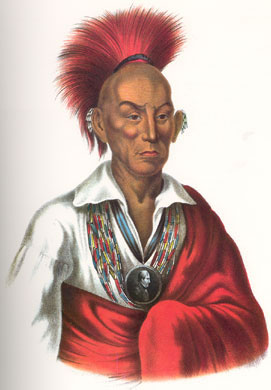
The Black Hawk War |
||
|
The Black Hawk War, essentially an extension of the Indian resistances that occurred throughout the south and midwest in the early 1800's, was the last major armed Indian resistance in the midwest. Led by the Sauk leader Black Hawk, about 2,000 Fox and Sauk Indians invaded Illinois in defiance of an 1804 treaty in which the Illinois Territory was ceded to the United States Government and opened to settlement. Fighting began after a Sauk emissary was murdered during peaceful negotiations. Although Black Hawk commanded his warriors to an initial victory over Illinois militia, dozens of subsequent battles over a four-month period reduced the Indian forces in northern Illinois and southern Wisconsin. On July 28, 1832, Black Hawk was overtaken in a bloody battle that resulted in the deaths of 68 of his warriors. On August 2nd, the remainder of Black Hawk's forced were massacred near the Bad Axe River in southern Wisconsin. Black Hawk was soon captured and the Sauk and Fox Indians were forced to cede another six million acres of land in eastern Iowa.
The Black Hawk War was the last major fight between Native Americans and the U.S. government in the Midwest. It was led by the Sauk leader Black Hawk and took place in 1832 when about 2,000 Fox and Sauk Indians went into Illinois, resisting a treaty made in 1804 that gave their land to the U.S. The war started when a Sauk diplomat was killed during peaceful talks. Though Black Hawk's warriors won an early battle, they were outnumbered in many other fights. After a bloody battle on July 28, 1832, where 68 of Black Hawk's men died, the rest were killed on August 2nd near the Bad Axe River. Black Hawk was captured, and his people were forced to give up more land. |
||