The Seminole Wars |
||
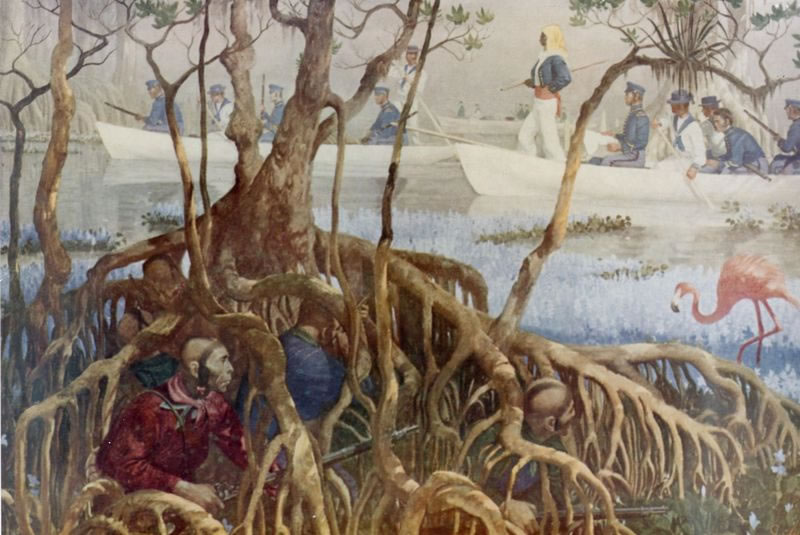
First Seminole WarThe Seminole Wars were three separate conflicts between the Seminole Indians and their allies and the U.S. Military. The First Seminole War began sometime between 1814 and 1817 when U.S. forces began capturing runaway slaves who had integrated with the Seminoles. Led by future president Andrew Jackson, 4,000 soldiers, including 2,000 Creek Indians, burned Seminole villages and crops and killed hundreds. Jackson proceeded to capture the Spanish towns of St. Mark’s and Pensacola. After Spain ceded Florida to the United States in 1821, thousands of settlers rushed into Florida, invading Seminole lands. Second Seminole WarAs American settlers crowded the Seminoles out of their land in the 1820’s and 1830’s, they banded together under Osceola, a half-White war chief whose bravery and determination inspired the resistance. The Seminoles lashed out against the settlers by destroying white plantations and routing a military detachment under the command of Major Francis Dade. As a result, the Seminoles temporarily regained control of a portion of their ancestral land. Up to 40,000 soldiers, volunteers, and Indians, under Zachary Taylor, Winfield Scott and others eventually dislodged the Seminoles from their positions, captured key Seminole leaders, stamped out Seminole ambush parties, and effectively surrounded the remaining resistance in the swamps of southern Florida. By 1842, the few remaining hostile bands of Seminoles, ragged and starving, were forced to surrender. Other bands of Seminoles persisted in the Everglades region for another decade and a half. Third Seminole WarIn 1857, the Seminoles made their last stand in what was known as the Third Seminole War, in which Seminole warriors were gradually defeated by various volunteer armies and militias. In all, over two thousand American soldiers were killed in the Seminole Wars along with many thousands of Seminoles. Most of the Seminoles would eventually be moved to reservations in Oklahoma.
First Seminole WarThe First Seminole War started between 1814 and 1817 when U.S. forces began capturing runaway slaves who had joined the Seminoles. Led by Andrew Jackson, 4,000 soldiers, including 2,000 Creek Indians, destroyed Seminole villages, crops, and killed many. Jackson also captured the Spanish towns of St. Mark’s and Pensacola. After Spain gave Florida to the U.S. in 1821, settlers rushed in and invaded Seminole land. Second Seminole WarIn the 1820s and 1830s, American settlers crowded the Seminoles out of their land. The Seminoles, led by Osceola, fought back, destroying plantations and defeating U.S. military forces. After many battles, including some led by future U.S. leaders, the Seminoles were pushed into the swamps of southern Florida. By 1842, most of the Seminoles had surrendered, though some remained hidden in the Everglades. Third Seminole WarIn 1857, the Seminoles made their last stand in the Third Seminole War. Volunteer armies and militias gradually defeated the remaining Seminoles. Over 2,000 U.S. soldiers died in the wars, along with many Seminoles. Eventually, most Seminoles were moved to reservations in Oklahoma. |
||